AMOLED vs LTPO OLED – Which Display Is Better?
AMOLED vs LTPO OLED: Both are high-quality display technologies used in modern smartphones. But how much better is LTPO OLED than standard AMOLED? In this guide, we’ll see which display technology is better in terms of battery life, refresh rate, brightness, gaming, and everyday usage.
What is AMOLED?
AMOLED stands for Active-Matrix Organic Light-Emitting Diode.
In an AMOLED display, each pixel emits light individually. So, unlike an LCD display, it doesn’t need a separate backlight.
Its key benefits include:
• Deep blacks
• High contrast
• Vibrant colours
• Thin display design
• Fast response time
• Lower power consumption in some situations when using dark mode
AMOLED displays are used in many of today’s mid-range and flagship smartphones.
What is LTPO OLED?
LTPO stands for Low-Temperature Polycrystalline Oxide.
Don’t think of LTPO as a completely different display technology from AMOLED. In smartphones, LTPO is commonly used in the backplane technology of OLED/AMOLED panels.
For example, an LTPO display can change the refresh rate as needed:
• Static image → very low refresh rate
• Reading → low refresh rate
• Normal scrolling → higher refresh rate
• Gaming → high refresh rate
This allows the display to use a higher refresh rate only when needed, helping to reduce battery consumption.
AMOLED vs LTPO OLED: The main difference
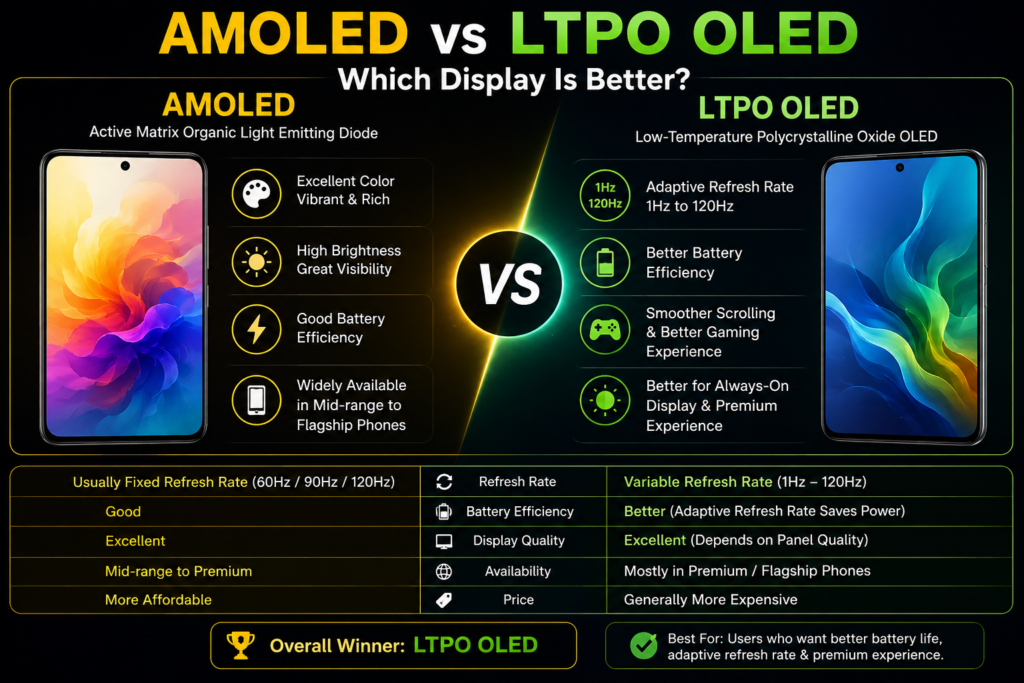
| Feature | AMOLED | LTPO OLED |
| Display quality | Excellent | Excellent |
| Black levels | Deep black | Deep black |
| Contrast | Very high | Very high |
| Refresh rate | Usually fixed or limited range | Wider variable range |
| Battery efficiency | Good | Better potential |
| Smooth scrolling | Excellent on high-refresh models | Excellent |
| Gaming | Very good | Excellent |
| Low refresh rate | Limited depending on panel | Strong advantage |
| Flagship usage | Common | Very common |
| Cost | Generally lower | Generally higher |
Important:
LTPO OLED’s display quality alone doesn’t automatically mean it’s better. Panel quality, brightness, calibration, resolution, and manufacturer tuning are also important.
1. Refresh Rate
The biggest practical difference between AMOLED and LTPO OLED is refresh-rate management.
A regular high-refresh AMOLED display can offer a 120Hz refresh rate. This makes scrolling and animations smoother.
In LTPO OLED displays, the refresh rate can be dynamically changed as needed.
For example:
Reading → Low Hz → Browsing → Higher Hz → Gaming → High Hz
This reduces the need for the phone to constantly run at maximum refresh rate.
Winner: LTPO OLED
If refresh-rate flexibility is important, LTPO OLED is better.
2. Battery Life
Display is one of the most important factors in smartphone battery consumption.
If a phone is constantly using a 120Hz refresh rate, it may require more power than a 60Hz or lower refresh rate in some usage scenarios.
LTPO technology can help reduce the refresh rate when it is not needed.
For example, when there is a static image on the screen, instead of constantly using a 120Hz refresh rate, a much lower refresh rate can be used.
This can improve battery efficiency depending on the usage pattern.
But LTPO alone does not determine battery life.
Battery capacity, processor efficiency, software optimization, brightness, network usage, and background apps are also important.
Winner: LTPO OLED
LTPO is a major advantage for battery efficiency.
3. Display Quality
Here is a common misunderstanding.
LTPO OLED does not automatically mean better image quality.
Both AMOLED and LTPO OLED can deliver excellent image quality.
Actual display quality is determined by:
- Resolution
- Peak brightness
- Colour accuracy
- HDR support
- Contrast
- Pixel density
- Panel quality
- Display calibration
A high-quality AMOLED panel may be visually better than a low-quality LTPO OLED panel.
Winner: Depends on the phone
You should not judge display quality by the technology name alone.
4. Gaming
High refresh rate is important in gaming.
A 120Hz display can provide a smoother experience in fast animations and supported games.
The advantage of an LTPO OLED display is the ability to dynamically adjust the refresh rate.
But the display alone does not determine gaming performance.
For gaming:
- Processor
- GPU
- Touch sampling
- Cooling system
- Game optimization
- Sustained performance
- are equally important.
Winner: LTPO OLED
The LTPO display is a useful advantage in a high-end gaming phone.
5. Scrolling Experience
High refresh rate gives a very smooth experience when browsing social media, websites and apps.
120Hz AMOLED display is already smooth.
LTPO OLED has a high refresh rate, but the refresh rate can be reduced when not needed.
So you can balance both smoothness + efficiency.
Winner: LTPO OLED
6. Brightness
Brightness is not just determined by the name AMOLED vs LTPO OLED.
A phone’s display brightness depends on its panel design and manufacturer implementation.
For example, a premium LTPO OLED display may have a higher peak brightness. At the same time, another AMOLED display may have a lower brightness.
So, it’s a good idea to check both peak brightness and typical brightness when looking at specifications.
Winner: Depends on the phone.
7. Always-On Display
Low refresh rate is very useful for the Always-On Display (AOD) feature.
When there is static information on the phone screen like a clock or notification, a high refresh rate is not needed.
LTPO technology is capable of going to very low refresh rates, which can help with power efficiency in use cases like AOD.
Winner: LTPO OLED.
8. Price
LTPO technology is usually found in premium smartphones.
As a result, phones with LTPO OLED displays are often in the flagship or upper-premium segment.
Standard AMOLED displays are available in a wide range of price ranges, from mid-range phones to flagship phones.
A good AMOLED phone can provide more value for budget-conscious buyers.
Winner: AMOLED.
AMOLED vs LTPO OLED – Which is better for you?
You can choose AMOLED if:
- Budget is important
- You want good display quality
- 90Hz/120Hz smoothness is enough
- Premium LTPO features are not necessary
- You are buying a mid-range smartphone
You can choose LTPO OLED if:
- You are buying a flagship smartphone
- You want better battery efficiency
- Adaptive refresh rate is important
- You want a premium display experience
- You are using an Always-On Display
- You want both smooth scrolling + power efficiency
AMOLED vs LTPO OLED: Final Verdict
Overall winner: LTPO OLED
But that doesn’t mean that all LTPO OLED displays are better than all AMOLED displays.
The biggest advantage of LTPO is variable refresh rate and power efficiency.
Even a good AMOLED display can provide an excellent viewing experience. Especially when buying a mid-range smartphone, an AMOLED display is a better choice.
But when buying a flagship smartphone, an LTPO OLED display can offer more practical benefits due to battery efficiency and adaptive refresh rate.
| Category | Winner |
| Refresh Rate Flexibility | LTPO OLED |
| Battery Efficiency | LTPO OLED |
| Gaming | LTPO OLED |
| Scrolling | LTPO OLED |
| Always-On Display | LTPO OLED |
| Value for Money | AMOLED |
| Premium Experience | LTPO OLED |
| Overall | LTPO OLED |
Frequently Asked Questions
1.AMOLED better or LTPO OLED?
LTPO OLED is generally the more advanced option due to its adaptive refresh rate and power efficiency. But display quality depends on panel quality.
2. Does LTPO OLED save battery?
Yes. LTPO helps reduce display power consumption by reducing the refresh rate when needed. Actual battery savings depend on the phone and usage pattern.
3. Is AMOLED display good?
Yes. High-quality AMOLED displays can deliver excellent contrast, deep blacks, and vibrant colors.
4. Is LTPO OLED good for gaming?
Yes. LTPO OLED is a good choice for flagship gaming experience due to its high refresh rate and adaptive refresh-rate capability.
5. 120Hz AMOLED vs 120Hz LTPO OLED – which is better?
LTPO OLED is generally the better choice because it can dynamically adjust refresh rate. But actual display quality, brightness, and color accuracy depend on the phone model.
6. Do all flagship phones have LTPO?
Not all flagship phones are required to have LTPO. It’s best to check the official specifications of a particular phone.
Final Takeaway
AMOLED is already an excellent smartphone display technology.
LTPO OLED offers advantages over it, such as adaptive refresh rate and better power-management capability.
Simply put:
AMOLED → Excellent display
LTPO OLED → Excellent display + smarter refresh-rate management
If you’re buying a budget or mid-range smartphone, a good-quality AMOLED display will suffice.
If you’re buying a premium flagship smartphone, LTPO OLED can be a valuable upgrade.
You can compare smartphone specifications and features on Comparelyst.com and choose the phone that suits your usage.