iPhone 17 Pro Max vs Google Pixel 10 Pro XL – Which is the Best Flagship Phone in 2026?
The iPhone 17 Pro Max vs Google Pixel 10 Pro XL comparison is an interesting one when it comes to buying a premium smartphone in 2026. Although both phones are big flagship models, their approaches are completely different. Apple has emphasized performance, professional video, camera consistency, battery life, and ecosystem experience in its iPhone 17 Pro Max. Google Pixel 10 Pro XL, on the other hand, focuses on photography, artificial intelligence, a clean Android experience, Google services, and long-term software support.
Just because a phone has more megapixels, it doesn’t automatically mean it’s a better camera. Similarly, the processor specification alone cannot determine the overall experience of a smartphone. Display quality, camera processing, software optimization, battery efficiency, and how we use the phone on a daily basis are the real differences.
In this comparison, we will look at the two flagship phones, iPhone 17 Pro Max and Google Pixel 10 Pro XL, in important areas such as design, display, performance, gaming, camera, video recording, selfie camera, battery, charging, software, AI features, durability and everyday usage.
iPhone 17 Pro Max vs Google Pixel 10 Pro XL – Design and Build Quality
Let’s first look at the design of the two phones.
Apple uses an aluminum unibody design in the iPhone 17 Pro Max. The front is made of Ceramic Shield 2 and the back is made of Ceramic Shield material. The iPhone 17 Pro Max has a height of 163.4mm, a width of 78mm and a thickness of 8.75mm. According to Apple India specifications, its weight is 231 grams.
As soon as you look at the design of the iPhone 17 Pro Max, you know that it is a premium flagship. The flat-edge design, large camera system and minimalistic Apple styling give it a distinctive appearance.
The design of the Google Pixel 10 Pro XL continues the familiar camera-bar identity of the Pixel series. It measures 162.8mm tall, 76.6mm wide, and 8.5mm thick. It weighs 232 grams. According to Google specifications, the Pixel 10 Pro XL uses a spacecraft-grade aluminum frame and Corning Gorilla Glass Victus 2 cover glass and back glass.
There is not much difference in weight between the two phones. Although the iPhone is slightly lighter, the difference will not be very big in daily usage.
The camera bar design of the Pixel 10 Pro XL helps to identify it easily from other smartphones. Pixel design generally has a clean and modern look.
Which phone is better in the design department is a very personal choice. If you like Apple’s premium minimalist design, the iPhone 17 Pro Max is attractive. If you like the Pixel’s unique camera-bar design, the Pixel 10 Pro XL is a good option.
Design winner: Personal preference
Display – iPhone 17 Pro Max vs Pixel 10 Pro XL
Both phones offer a flagship-level experience in the display department.
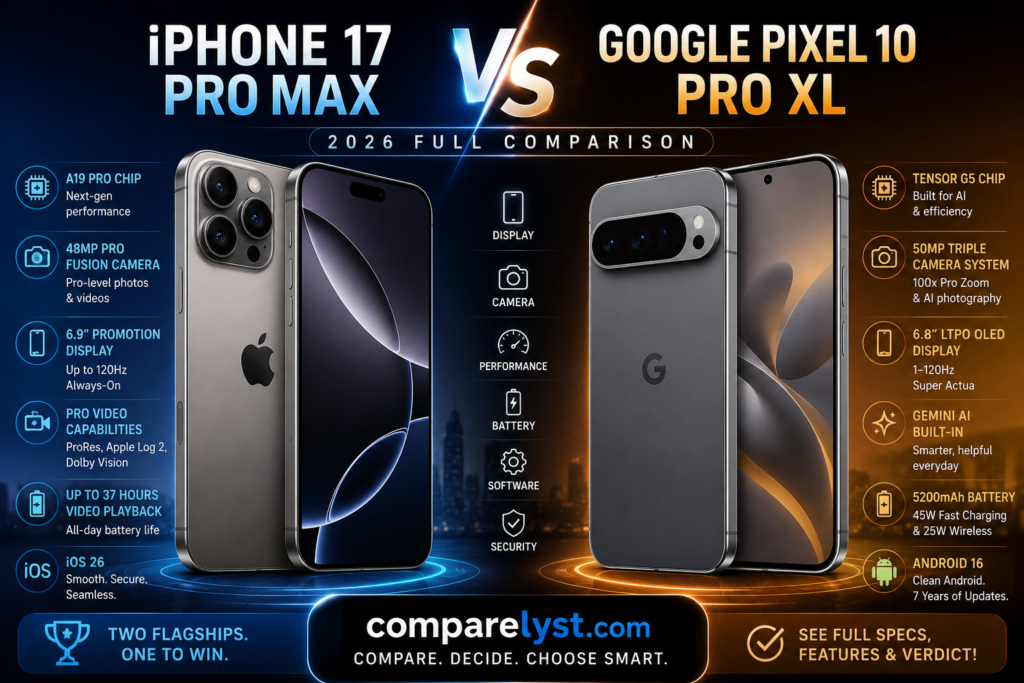
The iPhone 17 Pro Max has a 6.9-inch Super Retina XDR OLED display. Resolution 2868 × 1320 pixels and 460 ppi. Adaptive refresh rate up to 120Hz is provided by Apple ProMotion technology. There are also features like Always-On display, HDR, True Tone and P3 wide color. Apple states that outdoor peak brightness can go up to 3,000 nits.
This means that the iPhone display provides good visibility in bright outdoor environments. It is also an excellent screen for movies, YouTube videos, gaming and photo editing.
The Google Pixel 10 Pro XL has a 6.8-inch Super Actua display. Resolution 1344 × 2992 pixels and 486 ppi. It is an LTPO OLED panel and supports Smooth Display refresh rate from 1Hz to 120Hz. Google says that peak brightness will go up to 3,300 nits.
The Pixel has two interesting advantages here.
The first is its QHD-class resolution. Text and high-resolution content will be very sharp.
The second is the adaptive refresh rate from 1Hz to 120Hz. The refresh rate can be reduced when the screen is static and increased during scrolling or animations. This helps with power efficiency.
The iPhone 17 Pro Max’s 120Hz ProMotion display is smooth. The Pixel 10 Pro XL’s LTPO panel is also smooth and flexible.
In terms of brightness specification, the Pixel 10 Pro XL goes up to 3,300 nits peak brightness, while Apple says that the iPhone 17 Pro Max has 3,000 nits outdoor peak brightness.
In terms of display quality, both are excellent.
But when you add up the resolution, LTPO flexibility, and higher stated peak brightness, the Pixel 10 Pro XL gets a slight advantage.
Display winner: Google Pixel 10 Pro XL
Performance – A19 Pro vs Google Tensor G5
The two phones follow different philosophies in the performance department.
The iPhone 17 Pro Max uses the Apple A19 Pro chip. It has a 6-core CPU, 6-core GPU with Neural Accelerators, and a 16-core Neural Engine. It also has hardware-accelerated ray tracing support.
The key advantage of Apple chips is hardware and software integration. Apple optimizes its chip and iOS together, which results in consistent performance in demanding applications.
The iPhone 17 Pro Max is very powerful in tasks like photo processing, 4K video editing, gaming, multitasking, and professional applications.
The Google Pixel 10 Pro XL has a Google Tensor G5 processor and Titan M2 security coprocessor. The Pixel 10 Pro XL offers 16GB of RAM.
Google didn’t build Tensor processors just for raw benchmark performance. Since AI and machine-learning tasks are a key part of the phone experience, the Tensor G5’s strength is evident in AI processing and Google software integration.
Tensor G5 plays a key role in experiences like Gemini, photo editing, voice-related features, and contextual AI.
Normal daily usage on both phones is very smooth.
Both phones provide more than enough performance for regular tasks like WhatsApp, Instagram, YouTube, Chrome, email, banking apps, and social media.
But for users who need heavy gaming, professional video editing, and maximum raw performance, the iPhone 17 Pro Max may be more attractive.
For those who want an AI-focused smartphone experience, the Pixel 10 Pro XL is a meaningful choice.
Performance winner: iPhone 17 Pro Max
Gaming – Which phone is better?
For gaming, don’t just look at the processor. GPU performance, thermal management, display refresh rate, and game optimization are equally important.
The iPhone 17 Pro Max’s A19 Pro chip comes with hardware-accelerated ray tracing and Neural Accelerators. Apple has improved sustained performance with a new thermal architecture.
The iPhone 17 Pro Max is capable of high-end games, graphics-intensive titles, and demanding gaming sessions.
The Pixel 10 Pro XL also has a 120Hz LTPO display and Tensor G5 processor. The 120Hz refresh rate provides a smooth experience in Android gaming.
But the Google Pixel series generally emphasizes the camera and AI experience. The iPhone 17 Pro Max is more suitable for those who buy a phone with gaming as the primary reason.
Both phones will provide sufficient performance for casual gaming users.
But if long gaming sessions and maximum graphics performance are important, you can consider the iPhone 17 Pro Max.
Gaming winner: iPhone 17 Pro Max
Camera – iPhone 17 Pro Max vs Pixel 10 Pro XL
This is the most important part of this comparison.
The iPhone 17 Pro Max has a 48MP Pro Fusion camera system. It has three rear cameras: a 48MP Fusion Main camera, a 48MP Fusion Ultra Wide and a 48MP Fusion Telephoto camera. The Telephoto camera offers 4x optical zoom and an optical-quality 8x telephoto option. Digital zoom is up to 40x.
The main camera has second-generation sensor-shift optical image stabilization. The Ultra Wide camera offers a 120-degree field of view.
The biggest strength of Apple’s camera system is consistency.
Even when capturing the same scene in different lighting conditions, the colors, skin tones, exposure and HDR processing are generally balanced.
The iPhone also delivers good results for portrait photography.
The Google Pixel 10 Pro XL has a Pro triple rear camera system. It has a 50MP wide camera, 48MP ultrawide camera and 48MP 5x telephoto camera. Google offers up to 100x zoom with Pro Zoom.
The biggest strength of the Pixel camera is computational photography.
Google tries to improve details and exposure in difficult lighting conditions with its AI and image processing algorithms.
Night Sight, Real Tone, Face Unblur, Best Take, Magic Eraser, Zoom Enhance and AI-powered editing features make the Pixel camera experience very different.
The Pixel 10 Pro XL is very interesting in zoom photography.
It offers more flexibility in capturing distant subjects due to 5x optical telephoto and 100x Pro Zoom.
Pixel is very useful for users who photograph travel photography, portraits, buildings, animals or distant objects.
The optical-quality zoom experience is strong because of the 48MP telephoto system on the iPhone 17 Pro Max. But the Pixel’s 100x Pro Zoom is a very big number, specification-wise.
Here’s an important point.
Just because it has 100x zoom doesn’t mean every photo taken at 100x will be optical-quality. At higher zoom levels, computational processing plays a significant role.
So, don’t judge camera quality by the zoom number alone.
iPhone for natural-looking photos, consistent video, and a professional workflow.
Pixel for AI photography, computational processing, and long-range zoom.
Camera winner: Google Pixel 10 Pro XL for photography versatility
Night Photography – Pixel’s key strength
Low-light photography is a traditional strength of Pixel phones.
The Pixel 10 Pro XL has Night Sight and advanced computational photography features. The Google camera system uses AI processing to improve low-light photos and videos.
Google tries to balance shadows, highlights, and details by processing photos taken by the phone in dark environments through software.
The iPhone 17 Pro Max also has Night mode and computational photography features like Photonic Engine, Deep Fusion, and Smart HDR.
This makes night photography excellent on the iPhone.
But for those who want an AI-based computational photography experience, the Pixel 10 Pro XL is more attractive.
Night photography winner: Pixel 10 Pro XL
Video Recording – iPhone vs Pixel
The iPhone 17 Pro Max has a very strong advantage in video recording.
The iPhone 17 Pro Max supports HEVC, H.264, ProRes, and ProRes RAW formats. Apple Log 2, professional video features, Dolby Vision, and advanced stabilization are available.
The iPhone is very practical for professional content creators, YouTubers, filmmakers, and social media creators.
The Google Pixel 10 Pro XL also has significantly improved video capabilities.
According to Google specifications and product information, the Pixel 10 Pro series offers features like 8K video, Night Sight Video, and Video Boost. Video Boost helps stabilize high-motion scenes and create cinematic-looking output.
The Pixel’s 8K support is an interesting feature.
But resolution alone does not determine video quality.
Dynamic range, stabilization, autofocus, color consistency, audio, and editing workflow are equally important.
If professional video workflow and native recording reliability are important, the iPhone 17 Pro Max is very strong.
If you want AI-assisted video processing and 8K capability, the Pixel 10 Pro XL is attractive.
Video winner: iPhone 17 Pro Max
Selfie Camera – iPhone 17 Pro Max vs Pixel 10 Pro XL
Pixel 10 Pro XL has a big hardware advantage in the selfie camera department.
iPhone 17 Pro Max has an 18MP Center Stage front camera. It has features like Autofocus, Center Stage for photos and video calls, ultra-stabilized video, and Dual Capture. 4K Dolby Vision video recording and Cinematic mode are also available with the front camera.
Google Pixel 10 Pro XL has a 42MP Dual PD selfie camera. It offers autofocus and 103-degree ultrawide field of view.
Pixel’s wide field of view is useful when taking large group selfies.
It is also useful for travel vloggers or those who take a lot of group photos.
iPhone’s Center Stage feature helps in video calls and keeping moving subjects in the frame.
Pixel has a hardware advantage for selfie photography. iPhone is strong for video calls and creator-focused front camera features.
Selfie winner: Pixel for photos, iPhone for video calls
Battery Life – Which phone will last longer?
The two manufacturers use different metrics in battery comparisons.
Apple claims up to 37 hours of video playback and up to 33 hours of streamed video playback on the iPhone 17 Pro Max.
Apple doesn’t list battery capacity as a headline specification in mAh numbers, so comparing the iPhone to the Pixel directly by mAh numbers isn’t a good method.
The Google Pixel 10 Pro XL has a typical 5,200mAh battery. Google claims 24+ hour battery life and up to 100 hours of battery life when using Extreme Battery Saver.
The Pixel 10 Pro XL supports 45W USB-C PPS fast charging. Up to 25W Qi2-certified wireless charging is also available with Pixelsnap wireless charging.
Apple claims that the iPhone 17 Pro Max can charge to 50% in around 20 minutes with a 40W adapter or higher. There is also MagSafe and Qi2 wireless charging support.
While the Pixel has a larger battery capacity, actual battery life will vary depending on usage patterns.
Gaming, camera, 5G, brightness, and background apps will have a big impact on battery life.
Battery winner: iPhone 17 Pro Max for endurance; Pixel 10 Pro XL for battery capacity and charging flexibility
Software – iOS vs Android
The software experience is the biggest factor that separates these two phones.
The iPhone 17 Pro Max comes with iOS 26. Integration is very convenient if you have devices like Mac, iPad, Apple Watch, and AirPods in the Apple ecosystem.
iOS’s interface is relatively simple. Apps and system features are tightly integrated into the same ecosystem, so the user experience is consistent.
Google Pixel 10 Pro XL launched with Android 16. The Google Pixel experience is centered around a clean Android interface and Google services.
Pixel software has fewer unnecessary customizations. Google is showing its own vision of Android through Pixel phones.
Google says the Pixel 10 Pro XL will get seven years of OS, security, and Pixel Drop updates.
This is very important for long-term users.
iPhone is practical if you’re used to the iPhone ecosystem.
Pixel is practical if you like Google services, Android customization, and a clean software experience.
Software winner: Depends on preference
AI Features – Apple Intelligence vs Google Gemini
AI has become a major selling point in the 2026 smartphone market, not an optional feature.
The iPhone 17 Pro Max has Apple Intelligence built in. Apple is using it for communication, productivity, and system-level experiences. The A19 Pro chip and Neural Engine provide hardware support for AI workloads.
The Google Pixel 10 Pro XL’s biggest identity is AI.
The Tensor G5 processor is built for Google’s AI-first approach.
Features like Gemini, Gemini Live, Magic Cue, Camera Coach, and AI-powered photo editing are key parts of the Pixel experience. AI features like Camera Coach on the Google Pixel 10 Pro series provide composition and camera usage suggestions while taking photos.
The Pixel’s AI features are deeply integrated with the phone’s camera and the Google ecosystem.
For example, when editing a photo, you don’t need to use traditional editing controls. There are features that allow you to make edits using natural-language instructions.
Pixel 10 Pro XL is clearly more interesting for those who want to use more AI features.
AI winner: Google Pixel 10 Pro XL
Storage and RAM
The iPhone 17 Pro Max is available in 256GB, 512GB, 1TB and 2TB storage options.
The 2TB option is useful for creators who store a lot of 4K video footage or professional files.
Google India specifications mention that the Pixel 10 Pro XL has a 16GB RAM and 256GB storage configuration.
Performance should not be judged by the RAM number alone.
iOS memory management and Android memory management are different. So, even if the iPhone has less RAM number, it cannot be said that real-world performance will be lower.
iPhone advantage for users who need maximum local storage.
Storage winner: iPhone 17 Pro Max
Security and Privacy
The two companies take different approaches to privacy and security.
The iPhone 17 Pro Max uses Face ID and Apple’s security architecture. Apple says privacy protections are a priority for Apple Intelligence features.
The Pixel 10 Pro XL has a Titan M2 security coprocessor. Google offers security features like multi-layer hardware security, Trusty Trusted Execution Environment, and anti-malware and anti-phishing protections.
Both Fingerprint Unlock and Face Unlock are available on the Pixel.
The iPhone’s Face ID experience is more mature.
The Pixel’s fingerprint unlock is convenient for Android users.
Security winner: Tie
Water and Dust Resistance
The iPhone 17 Pro Max has an IP68 rating. According to Apple testing conditions, testing is specified up to a maximum depth of 6 meters for 30 minutes.
The Pixel 10 Pro XL also has an IP68 dust and water resistance rating.
Thus, both phones offer good protection in everyday situations like accidental water splash or rain.
But water resistance is not a permanent guarantee. It is not a good idea to intentionally use the phone underwater or test it in a swimming pool.
Durability winner: Tie
Everyday Usage – Which phone is practical?
We don’t use a smartphone just to check benchmark scores.
We check notifications in the morning. We reply to WhatsApp messages. We scroll through Instagram. We watch YouTube. We take photos. We use Google Maps. We open banking apps.
In this regular usage, both phones are excellent.
The advantage of the iPhone 17 Pro Max is consistency.
From opening the camera to recording a video, the experience is predictable.
The advantage of the Pixel 10 Pro XL is intelligence.
Google services and AI features help the phone act like a context-aware assistant.
If you want a simple and polished experience, go for the iPhone.
If you want to make the most of smart features and AI-based tools, go for the Pixel.
Which phone is better for content creators?
Both camera and video are important for content creators.
The iPhone 17 Pro Max has ProRes, ProRes RAW, Apple Log 2, and professional video workflow support.
This is a major advantage for YouTube creators, filmmakers, and professional video editors.
The Pixel 10 Pro XL has 8K video, Video Boost, Night Sight Video, and AI-based camera tools.
The Pixel is attractive to photography-based creators and those who use AI editing a lot.
But in professional video production, file workflow, editing compatibility, and predictable output are important, so the iPhone 17 Pro Max is a stronger choice.
Creator winner: iPhone 17 Pro Max for professional video
Who should buy the iPhone 17 Pro Max for?
The iPhone 17 Pro Max is a good choice for you if you use the Apple ecosystem.
If you already have a MacBook, Apple Watch, AirPods or iPad, the ecosystem integration is very useful.
It is also suitable for users who want professional video recording, powerful performance, long battery life, premium display and a consistent camera experience.
Even if you want a stable software experience after using the phone for many years, the iPhone is a practical choice.
Who should buy the Google Pixel 10 Pro XL for?
The Pixel 10 Pro XL is a flagship with a strong focus on photography and AI.
Its main strengths are Google Tensor G5, 16GB RAM, 6.8-inch LTPO OLED display, 5,200mAh battery, 45W charging, 50MP + 48MP + 48MP triple-camera system and 100x Pro Zoom.
The Pixel 10 Pro XL is very attractive to users who want a clean Android experience, Google ecosystem, Gemini AI, computational photography, and long-term software updates.
If photography and AI are your top priorities, you can seriously consider the Pixel.
Should you buy the iPhone 17 Pro Max in 2026?
The iPhone 17 Pro Max still offers a premium flagship experience in 2026.
Its major strengths are the A19 Pro chip, 6.9-inch 120Hz ProMotion display, 48MP Pro Fusion camera system, professional video features, Apple Intelligence, and strong battery life.
But before buying, it is better to compare the current market price and newer generation models.
If you want a premium Apple smartphone and ecosystem integration is important, the iPhone 17 Pro Max is still a strong choice.
Should you buy the Pixel 10 Pro XL in 2026?
Yes. The Pixel 10 Pro XL will still be relevant as a camera and AI-focused flagship in 2026.
Its major strengths are the Google Tensor G5, 100x Pro Zoom, 42MP selfie camera, 6.8-inch 120Hz LTPO OLED display and seven years of updates.
This is an interesting choice, particularly for users who use photography and Google AI features a lot.
iPhone 17 Pro Max vs Google Pixel 10 Pro XL – Final Verdict
Now let’s come to the important question.
iPhone 17 Pro Max or Google Pixel 10 Pro XL – Which is better?
There won’t be a clear winner for all users.
The iPhone 17 Pro Max is a flagship that focuses more on performance and professional video.
Its biggest advantages are the A19 Pro processor, 6.9-inch ProMotion display, 48MP Pro Fusion camera system, ProRes RAW, Apple Log 2, strong battery life and the Apple ecosystem.
The Google Pixel 10 Pro XL is a flagship focused on photography and AI.
Its major strengths are the Tensor G5, 16GB RAM, 6.8-inch LTPO OLED display, 5,200mAh battery, 45W charging, 100x Pro Zoom, 42MP selfie camera, Gemini and seven years of updates.
If raw performance and gaming are important – the iPhone 17 Pro Max.
If professional video recording is important – iPhone 17 Pro Max.
If photography and computational camera processing are important – Pixel 10 Pro XL.
If long-range zoom is important – Pixel 10 Pro XL.
If you use AI features a lot – Pixel 10 Pro XL.
If you use the Apple ecosystem – iPhone 17 Pro Max.
If you like clean Android and Google services – Pixel 10 Pro XL.
If you need maximum storage – iPhone 17 Pro Max.
If long-term software updates are important – Pixel 10 Pro XL.
So in terms of overall versatility, both phones have different strengths.
For professional performance and video, iPhone 17 Pro Max.
For photography and AI experience, Google Pixel 10 Pro XL.
Frequently Asked Questions
- iPhone 17 Pro Max vs Pixel 10 Pro XL – Which is the best overall?
No single phone can be said to be the best for everyone. iPhone 17 Pro Max is strong for performance, gaming, and professional video. Pixel 10 Pro XL is strong for photography, AI, and the Google ecosystem.
2. Is the Pixel 10 Pro XL display good?
Yes. The Pixel 10 Pro XL offers a premium display experience with a 6.8-inch Super Actua LTPO OLED display, 1–120Hz adaptive refresh rate, and up to 3,300 nits peak brightness.
3. Does the iPhone 17 Pro Max display support 120Hz?
Yes. The iPhone 17 Pro Max supports adaptive refresh rates up to 120Hz with ProMotion technology.
4. Is the Pixel 10 Pro XL camera good?
Yes. It has a 50MP main, 48MP ultrawide, and 48MP 5x telephoto cameras. Pro Zoom up to 100x is offered.
5. Is the iPhone 17 Pro Max camera better?
The iPhone 17 Pro Max is very strong for professional video and consistent photo/video output. It has three 48MP Fusion cameras and advanced Pro video formats.
6. Does the Pixel 10 Pro XL have 100x zoom?
Yes. Google offers up to 100x zoom range with Pro Zoom. But 100x is a computational zoom experience; it doesn’t mean you get optical-quality detail at all zoom levels.
7. How much battery does the Pixel 10 Pro XL have?
According to Google specifications, the Pixel 10 Pro XL has a typical 5,200mAh battery. It supports 45W USB-C PPS charging and up to 25W Pixelsnap wireless charging.
8. How is the iPhone 17 Pro Max battery life?
According to Apple specifications, the iPhone 17 Pro Max offers up to 37 hours of video playback and up to 33 hours of streamed video playback. Actual battery life will vary depending on usage.
9. How long will the Pixel 10 Pro XL get software updates?
Google says the Pixel 10 Pro XL will get seven years of OS, security, and Pixel Drop updates from launch.
10. iPhone 17 Pro Max or Pixel 10 Pro XL for gaming?
If heavy gaming and raw performance are important to you, the iPhone 17 Pro Max is a strong choice. The Pixel 10 Pro XL’s 120Hz display offers a smooth gaming experience, but for those whose primary priority is gaming, the iPhone is a better choice.
11. Which phone should you buy for photography?
If photography and AI-powered editing are important to you, the Pixel 10 Pro XL is a very attractive option. If professional video and consistent camera output are important to you, the iPhone 17 Pro Max is a better choice.
Final Thoughts
iPhone 17 Pro Max vs Google Pixel 10 Pro XL is not just a specification comparison of two flagship phones. It’s a comparison of two different smartphone philosophies.
The iPhone 17 Pro Max is a powerful, polished, and creator-friendly flagship. Its A19 Pro chip, ProMotion display, advanced camera system, professional video capabilities, and the Apple ecosystem are its key strengths.
The Google Pixel 10 Pro XL is a photography and AI-focused flagship. Tensor G5, Gemini, computational photography, 100x Pro Zoom, LTPO OLED display, large battery, and seven years of software support make it stand out.
If you want performance, gaming, professional video, and the Apple ecosystem, the iPhone 17 Pro Max might be the right choice for you.
If you want photography, AI, zoom, clean Android, and the Google ecosystem, the Pixel 10 Pro XL is more suitable for you.
Ultimately, it’s not a phone with more megapixels or more RAM that’s best. The phone that offers the most useful features and a better experience for your daily usage is the real best smartphone for you.
At Comparelyst.com, you can easily find the information you need to buy your next smartphone through smartphone comparisons, camera guides, display comparisons, performance articles, and mobile technology information.
Disclosure: As an Amazon Associate, Comparelyst earns from qualifying purchases.