OnePlus 15 vs Google Pixel 10 Pro XL – Speed vs Smarts: Which is the Best Flagship in 2026?
When it comes to buying a premium smartphone in 2026, the OnePlus 15 and Google Pixel 10 Pro XL are both very interesting choices. But the approach of these two smartphones is not the same. The OnePlus 15 emphasizes high performance, gaming, battery and fast charging. The Google Pixel 10 Pro XL, on the other hand, focuses more on camera intelligence, artificial intelligence, a clean Android experience and smart software features.
So the title of this comparison “Speed vs Smarts” is very appropriate for these two phones.
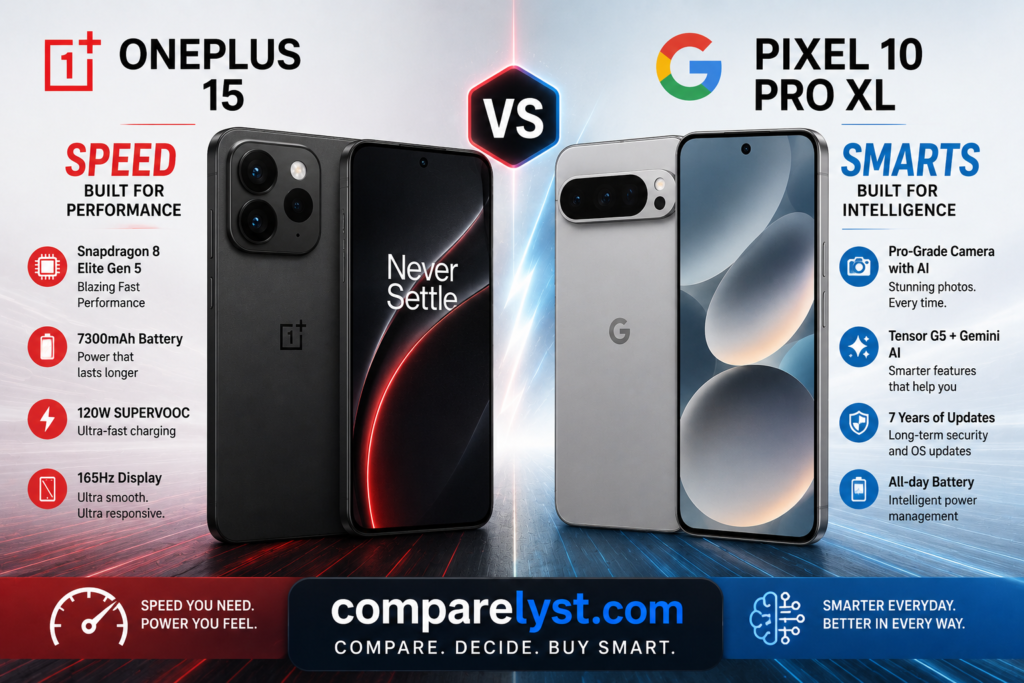
On one side, the OnePlus 15. Targets performance-oriented users with hardware features like a large battery, powerful Snapdragon processor, high refresh-rate display and extremely fast charging.
On the other side, the Google Pixel 10 Pro XL. Highlights software intelligence with Google’s Tensor G5 processor, Gemini-based AI features, advanced computational photography, smart camera tools and long software support.
Although both are flagship smartphones, there is no single answer to the question of “which is best?”.
If you are a gamer, you may like one phone. If photography and AI features are important, another phone may seem better.
So in this article, we will look at the OnePlus 15 and Google Pixel 10 Pro XL in several areas such as design, display, performance, gaming, camera, AI, battery, charging, software, everyday usage and value, and finally see which phone is right for which user.
OnePlus 15 vs. Google Pixel 10 Pro XL – Basic Differences
Let’s first understand the fundamental differences between these two phones. The OnePlus 15 can be described as a flagship phone that prioritizes performance, whereas the Google Pixel 10 Pro XL focuses primarily on AI features, camera intelligence, and the software experience. The OnePlus 15 is powered by the Snapdragon 8 Elite Gen 5 processor; its hardware specifications—such as 12GB or 16GB of RAM and fast UFS storage—are likely to appeal to users who prioritize performance. In contrast, the Pixel 10 Pro XL utilizes the Google Tensor G5 processor, which is engineered specifically to support Google’s AI capabilities and Pixel-exclusive software features. Consequently, comparing these two phones solely based on benchmark scores would not provide a complete picture. While the OnePlus 15 targets raw performance and gaming, the Pixel 10 Pro XL emphasizes AI processing, camera intelligence, and seamless Google software integration. It is precisely this distinction that makes the comparison so interesting.
Design – Both are Premium, but Styles Differ
When you first pick up a smartphone, its design is what immediately catches your eye. The OnePlus 15 adopts a modern flagship aesthetic; its large display, slim bezels, and clean rear design give it a premium look. On the other hand, the Google Pixel 10 Pro XL retains the signature horizontal camera bar design unique to the Pixel series. This is a key design element that instantly distinguishes the Pixel from other Android phones. While some users may love this camera bar design, those who prefer a simpler, cleaner look might gravitate towards the OnePlus 15. Regarding display size, the OnePlus 15 features a 6.78-inch screen, while the Pixel 10 Pro XL comes with a 6.8-inch Super Actua display. Therefore, both phones could be excellent choices for those who enjoy watching movies, using YouTube, gaming, or reading on a large screen. It is difficult to single out one phone as the winner in terms of design, as design is a matter of personal preference. If you prefer a performance-oriented, modern look, the OnePlus 15 might appeal to you; if you like the unique camera-bar design of the Pixel series, you are more likely to prefer the Google Pixel 10 Pro XL.
Display – OnePlus 15 vs. Pixel 10 Pro XL
In terms of display, both the OnePlus 15 and Google Pixel 10 Pro XL offer a premium flagship experience. The OnePlus 15 features a 6.78-inch display. It supports an adaptive refresh rate ranging from 1Hz to 120Hz and reportedly offers the capability to utilize a 165Hz refresh rate for gaming—an especially interesting feature for gaming enthusiasts. Thanks to the high refresh rate, supported games, scrolling, and animations feel incredibly smooth. On the other hand, the Pixel 10 Pro XL sports a 6.8-inch Super Actua LTPO OLED display with an adaptive refresh rate of 1Hz to 120Hz. The Pixel display’s key strengths lie in its brightness, color accuracy, and overall visual quality. High brightness proves useful for outdoor use, while the display also delivers an excellent viewing experience for movies, photos, and other media content. Therefore, rather than declaring a single winner, the choice depends on your usage habits. If gaming and ultra-smooth interaction are your priorities, the OnePlus 15 is an attractive option; conversely, those who value photography, movies, and overall visual quality might prefer the Pixel 10 Pro XL.
Performance – A key advantage for the OnePlus 15
If we simplify the performance comparison between these two phones as “Speed vs. Smarts,” the word “Speed” aptly describes the OnePlus 15. It is powered by the Snapdragon 8 Elite Gen 5 processor, a chip designed for flagship-level performance. This hardware configuration is ideal for users who require high performance for tasks such as opening apps, multitasking, gaming, video editing, and running demanding applications. The OnePlus 15 is likely to be particularly appealing to those who play high-end Android games. Meanwhile, the Pixel 10 Pro XL utilizes the Google Tensor G5 processor. While the Tensor G5 offers performance improvements over previous Pixel generations, Google did not design its processor solely to prioritize raw benchmark performance. The Tensor platform’s strengths truly shine in areas such as AI workloads, camera processing, voice-related features, and Google services integration. Consequently, the OnePlus 15 holds an advantage in terms of pure performance; it offers greater performance headroom for users who rely on heavy applications and demanding games. At the same time, the Pixel 10 Pro XL delivers a smooth experience during everyday use, with performance that is more than adequate for most users when handling apps like WhatsApp, Instagram, YouTube, Chrome, and Gmail. However, when it comes to demanding workloads and heavy gaming, the OnePlus 15’s performance-oriented hardware clearly provides an edge. Therefore, if pure performance and gaming are your top priorities, the OnePlus 15 emerges as the winner in this comparison.
Gaming – A major advantage for the OnePlus 15
Gaming is a key category where the OnePlus 15 holds a significant lead when comparing these two phones. Beyond just featuring the Snapdragon 8 Elite Gen 5 processor, OnePlus focuses on various aspects to enhance the gaming experience. Notably, the high-refresh-rate display contributes to a much smoother gaming feel. With the display capable of reaching a 165Hz refresh rate in gaming mode, animations and screen responsiveness in supported games are likely to be faster and more fluid. This offers a practical advantage for users who engage in long gaming sessions. While the Pixel 10 Pro XL can also handle modern games smoothly—and the Tensor G5 offers performance improvements over the previous generation—gaming is not the Pixel series’ sole focus; significant emphasis is also placed on the camera, AI, and the Google software experience. If you are a user who plays high-end games for two or three hours daily, the OnePlus 15 might be the more suitable choice. Conversely, the Pixel 10 Pro XL’s performance may suffice for casual gamers. Therefore, for users who prioritize gaming, the OnePlus 15 emerges as the clear choice in this comparison.
Battery – A key strength of the OnePlus 15
The OnePlus 15 also stands out in terms of battery performance. It is equipped with a 7,300mAh battery, representing a massive capacity within the flagship smartphone category. This size offers a significant advantage for heavy users. A large battery capacity proves practically beneficial for those who rely heavily on gaming, navigation, video streaming, social media, and mobile data throughout the day. It also provides peace of mind during travel or in situations where immediate access to charging isn’t available. The Pixel 10 Pro XL also features a large battery, with Google prioritizing software optimization and battery-saving features to ensure long-lasting endurance. Battery life can be further extended by utilizing options like “Extreme Battery Saver.” However, when considering raw battery capacity and performance-oriented heavy usage, the OnePlus 15 holds a noticeable advantage. If you are a gamer, a traveler, or a heavy user who spends a lot of time on the phone each day, the OnePlus 15 could be a very attractive option for you. At the same time, for normal daily usage—such as calls, messaging, social media, browsing, and occasional entertainment—the Pixel 10 Pro XL’s battery performance may well be sufficient for many users. Based on overall battery capacity and heavy usage, the OnePlus 15 emerges as the winner in this comparison.
Charging – OnePlus 15 leads in charging speed
When choosing a smartphone, looking solely at battery capacity isn’t enough; the speed at which the battery charges is equally important. The OnePlus 15 supports 120W SUPERVOOC wired charging. This allows you to gain a significant battery percentage during a relatively short charging session, eliminating the need to keep the phone plugged in for extended periods when the battery is low. Fast charging is highly practical for those rushing to work or frequent travelers; for instance, if you notice low battery before heading out in the morning, you won’t need to keep the phone charging for a long time. While the Pixel 10 Pro XL also supports fast wired charging, it offers additional features like Pixelsnap magnetic wireless charging. The convenience of wireless charging is a great feature, especially for users who prefer magnetic accessories. However, in terms of raw charging speed, the OnePlus 15 holds a clear advantage. Therefore, if charging speed is a priority, the OnePlus 15 takes the lead in this comparison.
Camera – The Pixel 10 Pro XL makes a strong comeback here
Although the OnePlus 15 leads in performance and battery, the Google Pixel 10 Pro XL emerges as a formidable competitor when it comes to the camera. For years, Google Pixel phones have prioritized computational photography. The Pixel 10 Pro XL features a “Pro” triple-camera setup—comprising a 50MP main camera, a 48MP ultra-wide lens, and a 48MP telephoto lens—along with up to 100x Pro Zoom capability. Google relies not just on camera hardware but also on software and AI processing. Enhancing elements like exposure, HDR, skin tones, shadows, highlights, and fine details through software processing after a photo is taken is a hallmark of the Pixel camera experience. The OnePlus 15 also boasts capable hardware, including a 50MP main camera and a 50MP telephoto camera, offering good flexibility for both everyday and zoom photography. However, when it comes to computational photography and AI-based camera processing, the Pixel 10 Pro XL’s approach might appeal more to many users. At the same time, camera quality can vary depending on the shooting conditions and personal preference. Both phones deliver excellent results in daylight photography with good lighting. Some users may prefer the Pixel’s natural-looking processing for portrait shots, and it also stands out as a strong option for low-light and night photography. Both phones are also capable when it comes to zoom photography. Taking the overall camera experience, computational photography, and AI-based image processing into account, the Google Pixel 10 Pro XL can be declared the winner in this camera comparison.
Daylight Photography
Both the OnePlus 15 and Google Pixel 10 Pro XL are capable of capturing excellent photos in bright daylight conditions. Photos taken with the OnePlus 15 tend to be sharp and detailed, with vibrant colors, offering a satisfying experience for casual photographers. The Pixel 10 Pro XL excels in delivering natural-looking colors and superior dynamic range. Its HDR processing proves particularly useful in challenging scenes containing a mix of bright skies, clouds, shadows, and high-intensity light areas within a single frame. For instance, when a building’s foreground is in shadow against a very bright background sky, the camera’s processing is crucial for balancing both areas; in such situations, the Pixel’s computational photography approach yields impressive results. Consequently, the OnePlus 15 may appeal to those who prefer vibrant, everyday snapshots, whereas the Pixel 10 Pro XL is likely to be favored by users who take photography more seriously.
Night Photography
Night photography is an area where the Pixel series has long excelled. The Pixel 10 Pro XL utilizes technologies such as Night Sight and AI-based image processing. Central to the Pixel camera experience is a computational photography approach that captures multiple frames in low light and combines them via software processing to enhance image quality. This enables the Pixel 10 Pro XL to deliver excellent results in scenarios like night street photography, indoor shots, and low-light portraits. While the OnePlus 15 also possesses the capable hardware and image processing features required for night photography, the Pixel 10 Pro XL’s approach—emphasizing camera intelligence, low-light processing, and computational photography—may be more appealing if those aspects are your priority. Therefore, for users who prioritize night photography, the Google Pixel 10 Pro XL holds the advantage in this comparison.
Zoom Photography
For those who enjoy zoom photography, both the OnePlus 15 and Google Pixel 10 Pro XL are phones worth considering. The OnePlus 15’s telephoto camera reportedly offers a 3.5x optical zoom and a 7x optical-quality zoom experience, making it practical for everyday zoom photography. On the other hand, the Pixel 10 Pro XL features a 48MP telephoto camera with up to 100x Pro Zoom capability. It relies heavily on Google AI and computational photography processing to deliver this long-range zoom experience. While 100x zoom isn’t something one would use for everyday photography, it can be useful in specific situations where you need to view or capture distant subjects. Greater zoom flexibility is an advantage when capturing concerts, buildings, wildlife, or distant objects. The OnePlus 15’s telephoto setup is a practical choice for standard daily zoom usage, whereas the Pixel 10 Pro XL offers greater flexibility for extreme zoom and AI-assisted photography. Therefore, if long-range zoom is a priority, the Pixel 10 Pro XL takes the lead.
Portrait Photography
Camera hardware alone isn’t enough for portrait photography. A good portrait relies on factors like natural skin tones, proper separation between the subject and the background, and the camera’s ability to accurately identify the subject. The Pixel 10 Pro XL uses AI and computational photography processing to refine portrait images, with Google placing particular emphasis on ensuring natural-looking facial details and background processing. The OnePlus 15 also offers a solid portrait photography experience; using the telephoto camera to capture the subject from a slight distance can help achieve a natural-looking perspective. Both phones are excellent options for users who take portraits and everyday photos for social media. However, for photography enthusiasts who value natural processing and computational photography, the Pixel 10 Pro XL stands out as an attractive choice. ### Video Recording – OnePlus 15 vs Pixel 10 Pro XL
Both the OnePlus 15 and Pixel 10 Pro XL have their own distinct strengths when it comes to video recording. The OnePlus 15 boasts advanced capabilities such as 4K 120fps Dolby Vision video recording. This type of recording can be particularly useful for content creators and mobile filmmakers who wish to capture high-frame-rate video, slow-motion footage, and fast-moving action scenes. Meanwhile, the Pixel 10 Pro XL is said to feature 8K video recording and “Video Boost.” It leverages Google AI and computational techniques for video processing, with Video Boost helping to enhance video quality in challenging lighting conditions. Consequently, one cannot definitively say that a single phone is the best for every user in the video category; the OnePlus 15 might appeal to those who prioritize high-frame-rate and cinematic-style shooting, whereas the Pixel 10 Pro XL could be a better fit for those who prefer AI-enhanced video processing and computational video features.
Selfie Camera
Regarding the selfie camera, the OnePlus 15 offers a good experience suitable for everyday users. Its front camera is likely sufficient for tasks like social media posts, video calls, and standard selfies. On the other hand, the Pixel 10 Pro XL features a 42MP autofocus front camera. Autofocus on the front camera proves useful for group selfies, capturing moving subjects, or creating video content. Front camera quality is particularly crucial for content creators, as the camera is used not just for selfies but also for talking-head videos, travel vlogs, and social media content. Given these use cases, the Pixel 10 Pro XL’s front camera setup may hold greater appeal for many users. Consequently, the Pixel 10 Pro XL takes the lead in this comparison for those who prioritize selfie photography, video calls, and content creation.
AI – The Pixel 10 Pro XL’s Greatest Strength
In the “Speed vs. Smarts” comparison, the term “Smarts” fits the Pixel 10 Pro XL perfectly. The Google Tensor G5 processor is reportedly designed with a strong emphasis on AI-related workloads. Gemini integration is a key component of the Pixel experience. Features like “Magic Cue” attempt to understand the user’s context and provide relevant information at the right moment. Tools like “Camera Coach” can assist with photography by offering suggestions on composition and framing. There is also the ability to interact with the AI regarding what you see through the camera via Gemini Live. These are not merely features dependent on processor speed; they are software-driven experiences that can subtly transform how one uses the smartphone. While the OnePlus 15 may also include AI features and intelligent software tools, Google holds a significant advantage through the deep integration of the Android and Gemini ecosystems. For users who wish to incorporate AI tools into their daily lives, the Pixel 10 Pro XL presents a highly attractive option. Therefore, if the AI experience is a priority, the Pixel 10 Pro XL leads in this category.
Software Experience
The OnePlus 15 offers an OxygenOS 16 software experience based on Android 16. OxygenOS typically prioritizes a clean interface, smooth animations, efficient multitasking, and customization options. The extensive customization features are likely to appeal to power users who enjoy personalizing their phones. OxygenOS delivers a great experience when it comes to quickly switching between apps, multitasking, and tailoring the interface to individual preferences. On the other hand, the Pixel 10 Pro XL offers Google’s signature Pixel software experience, which focuses on a clean Android interface and seamless integration with Google services. Elements like Material 3 design and smooth animations give the Pixel interface a modern look. One of the major advantages of Pixel phones is their extended software support; Google reportedly promises seven years of OS and security updates for the Pixel 10 Pro XL. This is a crucial factor for users planning to keep the same phone for several years. Consequently, while the OnePlus 15 might appeal to those who value customization and power-user features, the Pixel 10 Pro XL stands out as a strong choice for those prioritizing a clean software experience and long-term updates. When considering overall software support and long-term usability, the Pixel 10 Pro XL emerges as the winner in the software category.
AI vs. Customization
There is an interesting difference in the software approach of these two phones. The Pixel 10 Pro XL embodies the philosophy that “the phone should understand you.” It focuses heavily on using AI to provide suggestions and helpful features by understanding the user’s actions based on context. On the other hand, the OnePlus 15 follows the approach that “the phone should give you control.” It allows users to have greater control over their experience through customization options, performance settings, and gaming-related features. Consequently, if you are a user who relies heavily on AI features in your daily routine, you might prefer the Pixel 10 Pro XL. Conversely, if you wish to tailor the phone’s appearance, settings, and performance to your personal preferences, the OnePlus 15 offers greater flexibility.
Storage and RAM
Regarding RAM and storage, the OnePlus 15 offers various configurations, including options for 12GB and 16GB of RAM, as well as storage capacities of 256GB and 512GB. Higher RAM can be beneficial for users who engage in heavy multitasking, play demanding games, or use resource-intensive applications. The Pixel 10 Pro XL is also reported to feature a 16GB RAM configuration and multiple storage options. Ample storage is particularly helpful for those who store a large number of photos, videos, and large files on their device. For content creators, gamers, or those planning to use their phone for an extended period, opting for a higher storage variant might be the practical choice. However, high RAM or massive storage isn’t necessarily essential for everyone; it is best to choose a variant based on your specific daily usage needs.
Long-Term Usage
When buying a smartphone, it is wise to consider not just its current performance but also whether it will remain usable for the next four or five years. Thanks to its powerful hardware and large battery, the OnePlus 15 could be a viable choice for performance-oriented, long-term use. However, the Pixel 10 Pro XL holds a distinct long-term advantage that lies more in its software support than its hardware. Google has promised seven years of OS and security updates for the Pixel 10 Pro XL. Such software support is crucial for users who prefer to keep the same phone for several years. Even with powerful hardware, the user experience can feel dated over time if consistent software and security updates are not provided. Consequently, the Pixel 10 Pro XL emerges as an attractive long-term option for users planning to use the same smartphone for four or five years. When prioritizing long-term software support, the Pixel 10 Pro XL holds a clear advantage in this comparison.
Everyday Usage – Which phone is smoother?
When it comes to everyday usage, both the OnePlus 15 and the Google Pixel 10 Pro XL offer a great experience. Most users will likely enjoy a smooth experience on both phones while using common apps like WhatsApp, Instagram, YouTube, Chrome, Gmail, Google Maps, and Spotify. Thanks to its performance-focused hardware, the OnePlus 15 may excel at quickly switching between apps and handling demanding tasks. On the Pixel 10 Pro XL, Google’s software optimization and AI integration can make everyday interactions feel smooth and, at times, more intelligent. Users are likely to be satisfied with either phone for normal daily use. The real differences become apparent primarily in gaming, camera performance, and AI features. Therefore, for those who use only standard everyday apps, rather than declaring one phone vastly superior to the other, it is best to make a choice based on your specific usage patterns.
Which phone is best for students?
When choosing a smartphone for students, one must consider factors beyond just performance—such as battery life, multitasking capabilities, and useful software features. Thanks to its large battery and strong performance, the OnePlus 15 is well-suited for handling various tasks like attending online classes, reading PDFs, web browsing, note-taking, and even entertainment or gaming. A large battery offers a practical advantage for students who use their phones extensively, as it reduces the need to constantly search for a charger. Meanwhile, the AI features of the Pixel 10 Pro XL offer a different kind of utility for students; tools such as Gemini assistance, voice-based features, and camera-integrated functions can be leveraged for research and learning activities. Therefore, if battery life, performance, and overall practical utility are the priorities, the OnePlus 15 could be an attractive choice for students. However, if a student prefers utilizing AI features and the Google ecosystem, the Pixel 10 Pro XL would be a great alternative.
Which phone is for content creators?
Choosing between these two phones can be a bit of a dilemma for content creators, as each offers distinct strengths. With its high-frame-rate video capabilities, powerful hardware, fast charging, and large battery, the OnePlus 15 is well-suited for tasks like extended shooting sessions or performance-intensive editing; it may particularly appeal to those creating gaming-related or performance-focused content. On the other hand, the Pixel 10 Pro XL—with its advanced camera processing, 8K video, Video Boost, and AI-based tools—is likely to attract photography and video creators. Its computational photography and video processing features make it a valuable tool for travel creators and those focused on photography-heavy content. Ultimately, the right choice depends on the type of content you create: the Pixel 10 Pro XL is a strong contender for photography, travel, and camera-centric content, while the OnePlus 15 is better suited for gaming, performance-heavy tasks, and high-frame-rate content.
Which phone is for gamers?
For those who prioritize gaming, choosing between these two phones might be a relatively easy decision. The OnePlus 15 appears to be better suited for gaming-focused users. Features such as the Snapdragon 8 Elite Gen 5 processor, a high-refresh-rate display, a large battery, and gaming-specific optimizations can be highly beneficial for those who play demanding games for extended periods. The OnePlus 15 is a particularly strong option for serious gamers who value performance and smooth gameplay above all else. That said, this does not mean the Pixel 10 Pro XL is incapable of gaming; it performs well for normal and casual gaming. However, gaming is not the sole focus of the Google Pixel series; it places significant emphasis on camera capabilities, AI, and the software experience. Therefore, if gaming is a key part of your smartphone usage, choosing the OnePlus 15 would be the practical choice.
Which phone is for photography lovers?
The Google Pixel 10 Pro XL is an attractive choice for photography enthusiasts. Google’s approach to computational photography—along with features like AI-based image processing, Night Sight, Pro Zoom, and Camera Coach—makes the photography experience truly engaging. The Pixel places particular emphasis on enhancing details, exposure, dynamic range, and overall image appearance through post-capture software processing. While the OnePlus 15 also boasts capable camera hardware—making it a good option for everyday photography and zoom shots—users who value software intelligence and computational photography alongside hardware specs may prefer the Pixel 10 Pro XL. Consequently, in this comparison, the Pixel 10 Pro XL stands out as a strong choice for photography enthusiasts.
Which phone is best for battery-focused users?
The OnePlus 15 is a highly attractive option for heavy users who prioritize battery life. It features a combination of a 7,300mAh battery and 120W charging. A large battery offers a practical advantage during travel, extended gaming sessions, or heavy mobile data usage. Additionally, the fast charging capability ensures the phone is quickly ready for use again after the battery drains. While the Pixel 10 Pro XL also offers a good battery experience for both normal and heavy daily use, the OnePlus 15 stands out when considering raw battery capacity alone. Therefore, the OnePlus 15 is a suitable choice for users who prioritize both battery backup and charging speed.
Which phone is for AI users?
If you wish to make extensive use of AI features in your daily smartphone routine, the Google Pixel 10 Pro XL could be an excellent choice. Features such as Gemini integration, Magic Cue, Camera Coach, AI-based image editing, and integration with the Google ecosystem are key strengths of the Pixel experience. While the OnePlus 15 may also feature AI capabilities and smart software tools, the deep integration with Google’s AI ecosystem gives the Pixel phone a unique advantage. The Pixel 10 Pro XL is likely to offer greater value, particularly to users who frequently rely on AI tools, smart camera features, and Google services. Therefore, if the AI experience is a priority, the Pixel 10 Pro XL takes the lead.
Value for Money
When determining value for money, one must look beyond the price tag and consider the features and long-term benefits offered at that price point. Since the OnePlus 15 offers powerful hardware, a large battery, and fast charging, it may be an attractive option for users who prioritize hardware performance. On the other hand, the Pixel 10 Pro XL focuses on a premium camera experience, AI features, and extended software support. If you place a high value on hardware specifications, gaming, and battery life, the OnePlus 15 might seem like the better value proposition. However, if the camera, software experience, and AI features are what matter most to you, the Pixel 10 Pro XL might be the preferred choice. Consequently, there is no single “value-for-money winner” that suits everyone; it depends entirely on each user’s priorities.
Who should buy the OnePlus 15?
If you are a heavy gamer who prioritizes fast performance, a large battery, and very fast charging, the OnePlus 15 is likely to appeal to you. It is also a suitable choice for those who frequently utilize high refresh-rate displays and engage in intensive gaming or multitasking. The OnePlus 15 stands out as a strong flagship option, particularly for users who value raw hardware performance and speed over software intelligence. For users with heavy daily usage patterns, the combination of a large battery and fast charging offers a practical advantage.
Who should buy the Google Pixel 10 Pro XL?
If you are passionate about photography, enjoy using AI features daily, or are deeply integrated into the Google ecosystem, the Pixel 10 Pro XL could be the right choice for you. Key strengths of this phone include a clean Android experience, long-term software support, excellent portrait and night photography capabilities, and smart camera features. Photography enthusiasts who use their phone cameras frequently will likely appreciate the experience provided by the Pixel’s computational photography and AI-based processing. Additionally, the long-term software support is a significant advantage for those who intend to keep using the same phone for an extended period.
OnePlus 15 vs Pixel 10 Pro XL – Final Verdict
After a full comparison, a clear distinction emerges between these two phones. The OnePlus 15 is a performance-focused flagship, whereas the Pixel 10 Pro XL offers a flagship experience centered on intelligence and camera capabilities. The OnePlus 15 boasts hardware strengths such as the Snapdragon 8 Elite Gen 5 processor, a massive 7,300mAh battery, and 120W fast charging. Meanwhile, the Pixel 10 Pro XL shines with the Tensor G5 processor, a robust camera system, AI features, and extended software support. The OnePlus 15 leads in categories like gaming, performance, battery life, and charging speeds, while the Pixel 10 Pro XL excels in camera quality, AI integration, software experience, and long-term updates. Consequently, picking a single overall winner between the two may not be the right choice for every user. A simple way to understand this comparison is: choose the OnePlus 15 if gaming, speed, battery life, and charging are your priorities; choose the Google Pixel 10 Pro XL if camera quality, AI, software, and long-term updates matter most to you.
Which phone should you buy in 2026?
The phone you should buy in 2026 depends on your daily usage habits. If you are a hardcore gamer, the OnePlus 15 might be the logical choice. It is also an attractive option for those who prioritize high performance, heavy battery usage, and fast charging. On the other hand, if you have a keen interest in photography, want to use AI features daily, or prefer a clean Android experience with long-term software support, the Google Pixel 10 Pro XL is worth considering. If camera capabilities and software intelligence are paramount to you, the Pixel experience may offer greater value. Since both phones belong to the flagship category, you won’t have to compromise significantly on basic performance or overall smartphone quality with either device; the key is simply choosing the one that best aligns with your specific needs. Comparelyst.com Final Recommendation
In the view of Comparelyst.com, the OnePlus 15 and Google Pixel 10 Pro XL are flagship smartphones that target different types of users. The key strengths of the OnePlus 15 lie in performance, gaming, battery life, and charging capabilities. Conversely, the Google Pixel 10 Pro XL focuses heavily on the camera, AI, software experience, and long-term updates. Therefore, if speed and gaming are your priorities, you might consider the OnePlus 15; if photography and the AI experience matter more to you, the Pixel 10 Pro XL could be the right fit. The OnePlus 15 is a practical choice if you need a large battery and fast charging, whereas the Pixel 10 Pro XL is a strong option if long-term software support and a smart camera experience are what you value. Ultimately, judging a phone solely based on benchmark scores is not the right approach. Camera quality is crucial if you use the camera frequently; performance and thermal management are vital if gaming is a major part of your daily routine; and battery life and charging speeds matter if you use your phone all day long. Similarly, the Pixel experience may offer greater value to those who rely heavily on AI tools and Google services. Therefore, rather than simply following what others buy, the truly smart decision is to first understand your own daily usage patterns and choose the smartphone that best aligns with them.
Frequently Asked Questions
- OnePlus 15 vs Google Pixel 10 Pro XL – Which is faster?
OnePlus 15 has the advantage in raw performance and gaming-oriented usage. It is more suitable for demanding tasks due to its Snapdragon 8 Elite Gen 5 processor and high-performance hardware.
2. Which phone is better for camera?
Google Pixel 10 Pro XL is strong in camera and computational photography. It is a good choice for photography enthusiasts due to its AI-powered camera features, Night Sight, Pro Zoom and advanced image processing.
3. Is OnePlus 15 good for gaming?
Yes. The OnePlus 15 is suitable for serious gamers due to its high-end processor, high refresh-rate gaming display, large battery and gaming-focused optimizations.
4. Can Pixel 10 Pro XL do gaming?
Yes. The Tensor G5 processor can handle modern games. But the primary focus of Pixel is AI, camera and software experience rather than gaming.
5. Which phone is better for battery life?
OnePlus 15 has the advantage in raw battery capacity and heavy usage perspective. Its 7,300mAh battery is very attractive for heavy users.
6. Who is better in charging?
OnePlus 15 has the advantage in charging speed. Battery refill can be done faster due to 120W wired charging. The magnetic wireless charging convenience of Pixel 10 Pro XL is a separate advantage.
7. Which phone should you buy for AI features?
If AI experience is important, then Google Pixel 10 Pro XL. Features like Tensor G5, Gemini integration, Magic Cue and Camera Coach are Pixel’s biggest strengths.
8. Which phone is better for long-term usage?
If long-term software support is important, then Pixel 10 Pro XL is very attractive. Google offers seven years of OS and security updates for Pixel 10 Pro XL.
9. Which phone is for content creators?
If photography and AI-based video tools are important, then Pixel 10 Pro XL. If high-performance video recording, gaming and long battery sessions are important, then OnePlus 15.
10. OnePlus 15 or Pixel 10 Pro XL – Which should you buy in 2026?
There is no single answer. If performance, gaming, battery and charging are important, then OnePlus 15. If camera, AI, software and long-term updates are important, then Pixel 10 Pro XL.
Final Thoughts
Both OnePlus 15 and Google Pixel 10 Pro XL are phones with their own identity in the flagship smartphone market in 2026.
OnePlus 15 emphasizes hardware power.
Google Pixel 10 Pro XL emphasizes software intelligence.
That is why the title Speed vs Smarts is very appropriate for this comparison.
OnePlus 15 will seem like a powerful machine to you. Fast processor, huge battery, high refresh-rate display and extremely fast charging make it attractive to performance lovers.
Pixel 10 Pro XL will be like a smart assistant. AI helps when taking photos, the software tries to understand your usage, Gemini features simplify daily tasks, and long-term software support will help keep the phone relevant for years to come.
So the final decision is simple.
If you’re a power user, get the OnePlus 15.
If you’re a photography and AI lover, get the Google Pixel 10 Pro XL.
If you’re a gamer, get the OnePlus 15.
If you want a smart software experience, get the Pixel 10 Pro XL.
If you’re a battery and fast charging enthusiast, get the OnePlus 15.
If you’re a camera and long-term software support enthusiast, get the Pixel 10 Pro XL.
Both are great flagship phones. But specifications aren’t the deciding factor in which phone is actually best for you — it’s how well that phone fits your daily needs.
At Comparelyst.com, you can easily find the information you need to buy your next smartphone through smartphone comparisons, camera guides, display comparisons, performance articles, and mobile technology information.
Run your own comparison with scores on Comparelyst — free, no signup, 490+ phones.
Disclosure: As an Amazon Associate, Comparelyst earns from qualifying purchases.