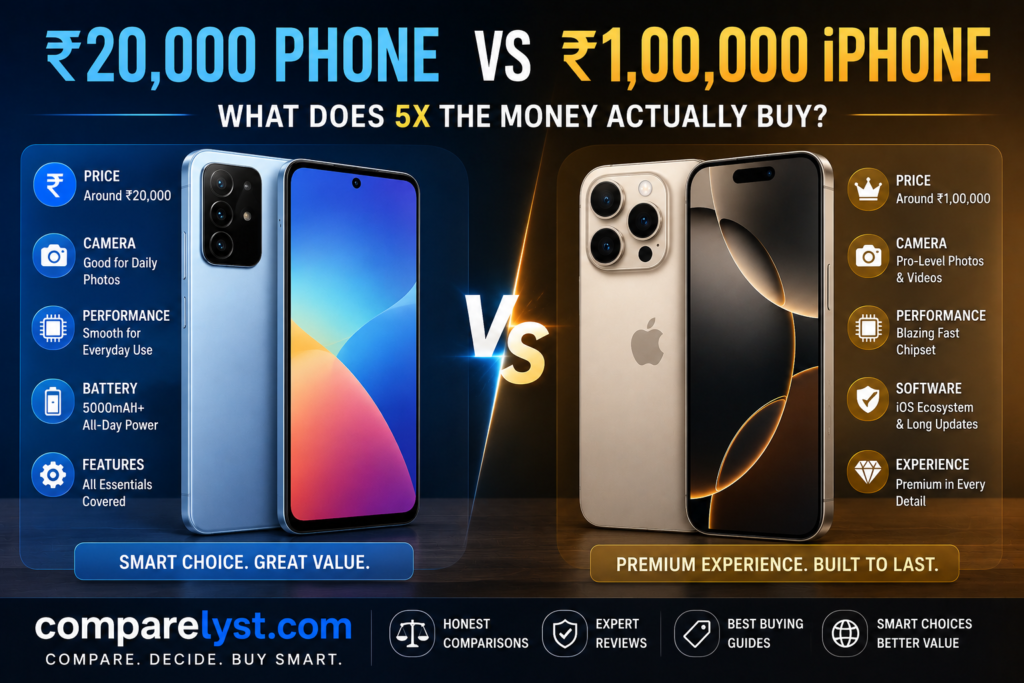
₹20,000 Phone vs. ₹1,00,000 iPhone – What do you actually get for paying 5 times the price?
When buying a smartphone, the first question that comes to many of us is: “Why spend ₹1,00,000 when a ₹20,000 phone would suffice?”
This is a perfectly valid question.
In today’s smartphone market, even within a ₹20,000 budget, you can get features like a large display, a good camera, a powerful processor, a large battery, fast charging, and a modern design. Meanwhile, in the ₹1,00,000 range, you can buy a flagship-level iPhone. If you hold both phones in your hand, they are both smartphones; you can use WhatsApp, watch YouTube, use Instagram, take photos, and make calls on both.
So, what is the real reason for buying a ₹1,00,000 iPhone instead of a ₹20,000 phone?
This is where the comparison gets interesting.
A ₹1,00,000 phone isn’t necessarily five times better than a ₹20,000 phone. Even though the price is five times higher, performance or camera quality won’t be five times better in every category.
Then, what is that extra ₹80,000 paying for?
The price difference stems from factors like build quality, camera consistency, processor performance, software optimization, the ecosystem, long-term software support, resale value, privacy features, display quality, and the overall premium experience.
In this article, let’s take a simple look at the actual differences between a ₹20,000 smartphone and a ₹1,00,000 iPhone.
First, an important point: a five-fold price increase doesn’t mean five-fold performance.
This is the first thing to understand when comparing a ₹20,000 phone and a ₹1,00,000 iPhone.
A ₹1,00,000 phone won’t be 5x faster. While it might take two seconds to open WhatsApp on a ₹20,000 phone, a ₹1,00,000 iPhone can open the same application in a fraction of a second; however, an average user might not perceive this difference as significant in daily use.
Similarly, there is no reason why a ₹20,000 phone cannot play 4K YouTube videos; after all, we watch YouTube on premium iPhones as well.
Therefore, the value of an expensive phone does not lie in a single specification.
It is the combination of many small improvements that creates an overall premium experience.
That is the key point of this comparison.
₹20,000 Phone – What do you get now?
A few years ago, a budget of ₹20,000 was considered the entry-level or basic smartphone segment.
But that situation has changed.
In the ₹20,000 range, you can get features like an AMOLED display, high refresh rate, a capable processor, a multi-camera setup, a large battery, and fast charging.
For an average user, these features may be sufficient.
Phones in this price range can easily handle everyday tasks such as WhatsApp, Instagram, Facebook, YouTube, Netflix, Chrome browsing, online shopping, UPI apps, and video calls.
Some phones also deliver good gaming performance.
So, buying a ₹20,000 phone does not mean buying a “cheap phone.”
It can be considered smart budgeting.
If your usage is basic to moderate, a ₹20,000 phone will handle most of the tasks you need.
₹1,00,000 iPhone – Where does the extra money go?
Now, let’s look at the ₹1,00,000 iPhone.
At this price point, you aren’t just buying phone hardware.
You get Apple’s hardware, software, and ecosystem all in one package.
Premium materials, a powerful processor, high-quality cameras, advanced display technology, optimized software, and long-term support are all part of the price.
Furthermore, within the Apple ecosystem, the iPhone is not just a standalone device.
Its convenience is enhanced when used in conjunction with devices like the Mac, Apple Watch, AirPods, and iPad. There is a difference between the value derived from using an iPhone in isolation and the value gained from using it within the complete Apple ecosystem.
Performance – How big is the actual difference?
Performance is one of the biggest strengths of an expensive iPhone.
Capable processors are now available in ₹20,000 phones. They handle tasks like social media, browsing, streaming, and normal multitasking quite well.
However, the advantage of a flagship processor becomes apparent in areas like heavy applications, advanced gaming, high-resolution video editing, and long-term performance.
A premium iPhone’s processor offers more than just raw performance.
Its hardware and iOS software are tightly optimized.
This makes tasks like launching applications, animations, video processing, and gaming feel smooth.
Furthermore, a flagship processor is more likely to remain capable and usable even after several years.
Everything might feel smooth on a ₹20,000 phone today.
But after two or three years, as applications become heavier and newer software versions arrive, the performance gap may start to show.
This is the long-term advantage of an expensive phone.
Gaming – Is a ₹20,000 phone enough?
If gaming is your main requirement, there is no need to completely ignore ₹20,000 phones.
Even in this budget range, there are phones with high-refresh-rate displays and capable gaming processors.
You can play casual games, multiplayer games, and many popular titles at reasonable settings.
However, the flagship iPhone holds an advantage in sustained performance.
A powerful processor and optimized software help when playing high-end games for extended periods with high graphics settings.
Flagship phones have the edge in areas like frame stability, loading times, and overall responsiveness.
But there is an important question to consider.
Do you game for two or three hours every day?
If not, is it necessary to spend an extra ₹80,000 for that additional performance?
The answer depends on your usage.
Camera – The difference might be significant here
Camera hardware in ₹20,000 phones has improved significantly.
In daylight photography with good lighting, affordable phones can capture great photos.
Those photos are often good enough for uploading to social media.
However, the advantage of a flagship iPhone camera becomes most apparent in challenging situations. A premium camera system strives to deliver consistent results across scenarios such as low-light photography, moving subjects, skin tones, HDR, video stabilization, and changing lighting conditions.
A good camera is not just about taking a good photo.
Delivering predictable results every time is crucial.
For instance, imagine a child running.
On an affordable phone, the photo might turn out blurry due to shutter lag or focusing issues.
A flagship camera, thanks to faster processing and autofocus, can capture that moment much better.
It is in such real-world situations that the price difference becomes significant.
Video – A major advantage of the iPhone
The advantage of flagship phones over mid-range ones might be even more apparent in video recording than in still photography.
You can certainly shoot social media videos, family videos, and casual clips on a ₹20,000 phone.
However, a flagship phone is highly beneficial for content creators, YouTubers, or anyone aiming to produce professional-looking videos.
Factors like stabilization, autofocus, exposure control, audio processing, dynamic range, and color consistency all impact video quality.
When recording a moving subject, camera shake needs to be minimal.
Exposure should adjust smoothly when transitioning between indoor lighting and outdoor sunlight.
In such situations, the premium hardware and software processing found in high-end phones offer a distinct advantage.
Consequently, the higher price tag of a ₹1,00,000 iPhone can sometimes be justified for video creators.
Display – Is the difference visible to the eye?
The display is a feature where the difference in an expensive phone is immediately noticeable.
Since AMOLED and high-refresh-rate displays are available in the ₹20,000 segment, the viewing experience on affordable phones is also quite good.
The difference might seem negligible when watching YouTube or Instagram, or even movies.
However, a premium iPhone display offers greater refinement in areas like brightness, color accuracy, HDR experience, touch response, and overall calibration.
Display brightness is crucial when using the phone in outdoor sunlight.
Brightness and contrast are vital when watching HDR video.
Touch response is key for gaming.
All these small improvements combine to create a premium feel.
However, for purely “WhatsApp + YouTube” usage, a display on a ₹20,000 phone might be perfectly adequate.
Build Quality – A difference felt the moment you hold it
Phones in the ₹20,000 range can feature very attractive designs.
Some even offer a premium-looking finish.
However, when you hold a ₹1,00,000 iPhone, you can feel a distinct difference in the materials and construction quality.
A premium metal frame, high-quality glass, and precise manufacturing create that expensive feel.
Small details like the buttons, vibration feedback, speaker quality, and overall construction also contribute to the premium experience. An interesting point here is that you cannot judge a phone’s quality solely by its design.
Some ₹20,000 phones might look very premium.
However, flagship phones often hold an advantage when it comes to long-term durability and internal build quality.
Software Experience – Simple vs. Premium
The software experience on ₹20,000 Android phones varies significantly depending on the brand.
Some phones offer a clean interface.
Others may come with a lot of additional applications and custom features.
The iOS experience on an iPhone is highly controlled.
Since Apple develops both the hardware and the software, the integration is seamless.
Animations, notifications, privacy controls, and system-level features remain consistent.
One user might prefer the freedom offered by Android.
Another might prefer the simplicity of iOS.
Ultimately, when it comes to software, the “best” choice depends on personal preference.
Software Updates – Where Long-Term Value Becomes Apparent
When buying a smartphone, you shouldn’t look only at the purchase date.
You also need to consider how many years you intend to use the phone.
For a ₹20,000 phone, the software support model and the duration of updates can vary from brand to brand.
A major advantage of a flagship iPhone is its long-term software support.
Since new iOS versions remain available for years, the phone’s useful lifespan is extended.
Therefore, you shouldn’t calculate the cost of a ₹1,00,000 phone based on a single year of use.
If you use it for five years, the annual cost works out differently.
Conversely, if you have to replace a ₹20,000 phone after just two years, the total cost of ownership changes accordingly.
Battery – A higher price doesn’t guarantee a larger battery
There is a common misconception here.
You cannot simply assume that a ₹1,00,000 phone will always have better battery life than a ₹20,000 phone.
Some affordable Android phones may actually come with large battery capacities.
They can deliver a full day—or even longer—of battery life.
An iPhone’s advantage isn’t limited to just battery capacity.
Processor efficiency, software optimization, and power management play crucial roles in the overall battery experience.
Therefore, you shouldn’t judge performance solely by “higher mAh = better battery.”
Real-world screen-on time is what truly matters.
Charging – Affordable phones sometimes take the lead
In this category, ₹20,000 phones can sometimes hold an advantage over expensive iPhones.
Many Android phones place a strong emphasis on fast charging.
Being able to charge the battery significantly in a short time is extremely useful for busy users.
The iPhone’s charging experience varies depending on the specific model and the charger setup used.
So, if fast charging is a top priority for you, a ₹20,000 or mid-range Android phone might be the more practical choice.
This serves as a good example.
An expensive phone isn’t automatically the winner in every category.
Speakers and Haptics – Small differences, big impact
Many people overlook aspects like speaker quality and vibration motors when checking smartphone specifications.
However, these features are used constantly in daily life.
Vibration while typing on the keyboard.
Haptic feedback for notifications.
Speakers while watching YouTube.
Audio quality during calls.
Flagship phones strive for greater refinement in these finer details.
A ₹20,000 phone might also feature stereo speakers.
However, a flagship device may still lead in areas like sound separation, bass response, and haptic precision.
This difference won’t show up on a specification sheet.
It is something you can only truly appreciate through daily use.
Connectivity and Everyday Features
₹20,000 smartphones offer plenty of modern connectivity features.
Many models come equipped with features like 5G, Wi-Fi, Bluetooth, and NFC.
However, flagship iPhones may offer a more refined integration of connectivity hardware and software. However, a normal user might not notice a significant difference.
If you only need basic connectivity, an affordable phone is sufficient.
Privacy and Security – a key strength of the iPhone.
Smartphones contain sensitive information such as personal photos, banking applications, passwords, and private conversations.
Therefore, security is crucial.
Apple treats privacy and security as integral parts of its ecosystem.
iPhones have a strong reputation for secure authentication, app permissions, and system-level security.
Android phones also have security features.
However, the experience can vary depending on the brand and software implementation.
For a user who prioritizes privacy, the value of a premium iPhone may be greater.
Ecosystem – This is where Apple truly stands out
If you buy just an iPhone, its value is limited to that device alone.
However, if you own a MacBook, Apple Watch, AirPods, or iPad, the value of the iPhone increases.
Conveniences like copying content on one device and using it on another, seamlessly continuing calls and messages across the ecosystem, and syncing photos simplify your daily workflow.
You can certainly use the Google ecosystem and Android accessories with a ₹20,000 Android phone.
However, the tight integration of the Apple ecosystem is one reason for its premium pricing.
Resale Value – An important factor often overlooked
Many people do not consider resale value when buying a smartphone.
A ₹20,000 phone might fetch a low price in the used device market after two or three years.
Premium iPhones generally enjoy comparatively strong demand in the used market.
This gives you the opportunity to recover a portion of the initial purchase cost when selling your old iPhone to buy a new model.
Therefore, the full ₹1,00,000 cost of an iPhone shouldn’t be viewed merely as an expense.
You need to consider the purchase price, usage period, and resale value together.
Who is a ₹20,000 phone right for?
A ₹20,000 phone is a sensible choice if your usage is limited to WhatsApp, YouTube, Instagram, calls, browsing, and casual photography.
It is a good option for students, first-time smartphone buyers, and budget-conscious users.
An affordable phone may also suffice for moderate gaming.
The ₹20,000 segment is also practical for those who prefer to upgrade their phone every two or three years.
For these users, buying a ₹1,00,000 iPhone might be an unnecessary expense.
Who is a ₹1,00,000 iPhone right for?
A premium iPhone is useful if you are heavily involved in photography and video creation.
If gaming performance is a priority, you benefit from the flagship processor.
Long-term software support adds value if you intend to use the phone for several years.
You gain the ecosystem advantage if you already own Apple devices like a MacBook or Apple Watch. If premium build quality, camera consistency, and a smooth software experience are important to you, the extra cost of an iPhone can be justified.
When is spending an extra ₹80,000 worth it?
This is the key question of this entire comparison.
When can we say that spending an extra ₹80,000 is worth it?
If you actually make use of those premium features.
For a content creator who produces videos daily, a better camera and video system are useful.
For a professional who uses the phone as a work device every day, performance and reliability are important.
For an Apple ecosystem user, seamless connectivity is useful.
For a photography enthusiast, camera consistency is valuable.
For a long-term user, software support is important.
In these situations, the extra money can be seen as an investment.
When is spending an extra ₹80,000 unnecessary?
If you use the phone only for basic communication:
WhatsApp.
YouTube.
Instagram.
Calls.
UPI.
Browsing.
Occasional photos.
For this type of usage, a ₹20,000 phone might be sufficient.
Even if you buy an expensive phone, if you don’t use its advanced features, you won’t get the value for that extra money.
It’s like buying a Ferrari and driving it only in traffic.
It has the power.
But that power isn’t being utilized.
The same logic applies to smartphones.
₹20,000 Phone vs. ₹1,00,000 iPhone – Who is the real winner?
There is no universal winner in this comparison.
The biggest strength of a ₹20,000 phone is value.
The biggest strength of a ₹1,00,000 iPhone is refinement.
A ₹20,000 phone offers the ability to handle most everyday tasks at a lower cost.
A ₹1,00,000 iPhone handles those same tasks with more polished hardware, software, and ecosystem integration.
For an average user, the practical difference between the two phones might sometimes be minimal.
But for a power user, that difference is noticeable every day.
Final Verdict – What does that 5x cost actually buy you?
The ₹80,000 difference between a ₹20,000 phone and a ₹1,00,000 iPhone isn’t spent entirely on “speed” or “camera megapixels.” Here is what you get for that extra money:
Better overall camera consistency.
More powerful flagship performance.
Premium build quality.
Advanced display experience.
Refined software optimization.
Long-term software support.
Better ecosystem integration.
Strong security and privacy features.
Potentially better resale value.
And most importantly, a more polished overall experience.
However, not all of these are equally valuable to every user.
For a student, a ₹20,000 phone might be the smart choice.
For a photographer, a ₹1,00,000 iPhone might be the practical choice.
For a gamer, performance is key.
For a content creator, the camera and video capabilities are crucial.
For an Apple ecosystem user, integration is important.
Therefore, there is no simple answer to the question, “Is a ₹1,00,000 iPhone 5x better?”
But is a ₹1,00,000 iPhone significantly better than a ₹20,000 phone in key areas? Yes, it is.
Its value depends entirely on how you use it.
Spending extra money on features you won’t use isn’t smart buying.
At the same time, if a premium experience—regarding the camera, performance, software, ecosystem, and long-term support—matters to you in your daily use, then there is a valid reason to buy an expensive phone.
Ultimately, keep this simple rule in mind when buying a smartphone:
“The most expensive phone isn’t necessarily the best phone. The best phone is the one that perfectly suits your needs.”
If a ₹20,000 phone satisfies 90% of your requirements, it is up to you to decide whether the remaining 10% is worth an extra ₹80,000.
However, if that extra 10% plays a crucial role in your photography, gaming, work, content creation, or daily experience, then the premium price of a ₹1,00,000 iPhone might well be justified.
That is the real answer to the comparison between a ₹20,000 phone and a ₹1,00,000 iPhone.
Frequently Asked Questions
- Is a ₹20,000 phone sufficient?
Yes. A good ₹20,000 smartphone is adequate for everyday tasks like WhatsApp, YouTube, Instagram, browsing, calls, UPI, and casual photography.
2. Is a ₹1,00,000 iPhone five times faster?
No. A price that is five times higher does not mean the performance is five times better. The value of a premium phone comes from a combination of factors like the camera, software, build quality, ecosystem, and long-term support.
3. Can you get a good camera on a ₹20,000 phone?
Yes. Even affordable smartphones can take good photos in favorable lighting conditions. However, flagship phones generally hold the advantage in challenging lighting, video recording, stabilization, and consistent image quality.
4. Is it worth spending ₹1,00,000 on an iPhone?
It depends on your usage. If features like the camera, video capabilities, gaming, long-term software support, and the Apple ecosystem are important to you, it could be worth it. For basic usage, a ₹20,000 phone might suffice.
5. Who should buy a ₹20,000 phone?
The ₹20,000 range is a good option for students, budget-conscious users, those with basic-to-moderate usage needs, and people who prefer to upgrade their phone every two or three years.
6. Who is a ₹1,00,000 iPhone suitable for?
A premium iPhone offers great value to content creators, photography enthusiasts, power users, those already in the Apple ecosystem, and people who intend to use the same phone for several years.
7. Does an expensive phone guarantee better battery life?
Not necessarily. Battery life depends on more than just battery capacity; processor efficiency, the display, software optimization, and usage patterns also play crucial roles.
8. ₹20,000 phone vs. ₹1,00,000 iPhone – which is ultimately the best?
Best value: ₹20,000 phone.
9. Best premium experience: ₹1,00,000 iPhone.
Best choice for you: The phone that aligns with your actual usage needs and budget.
At Comparelyst.com, you can easily find the information you need to buy your next smartphone through smartphone comparisons, camera guides, display comparisons, performance articles, and mobile technology information.
Disclosure: As an Amazon Associate, Comparelyst earns from qualifying purchases.