Best Smartphone 2026 – iPhone vs Samsung vs Pixel: Which is really better?
Choosing a single brand is not an easy task when you are thinking of buying a new flagship smartphone in 2026. All three companies – Apple, Samsung and Google – offer different experiences in their flagship phones. Apple’s iPhone 17 focuses on performance and video experience. Samsung Galaxy S26 highlights compact flagship design, versatile camera and Galaxy AI features. Google Pixel 10 Pro XL focuses more on camera, artificial intelligence and clean Android experience.
So there is no single answer to the question “Which is the best smartphone in 2026?”. For one user, the iPhone 17 may be the best phone. For another, the Samsung Galaxy S26 may be the best. For someone who uses camera and AI features a lot, the Google Pixel 10 Pro XL may be more attractive.
In this comparison, we will not only look at these three phones based on specifications, but also on important areas such as everyday usage, display, performance, camera, video, gaming, battery, charging, AI, software, design and long-term usage.
Why are these three phones important in 2026?
In the smartphone market, a flagship phone cannot be said to be only high price and high specifications. Now, software and AI experience have also become equally important as hardware.
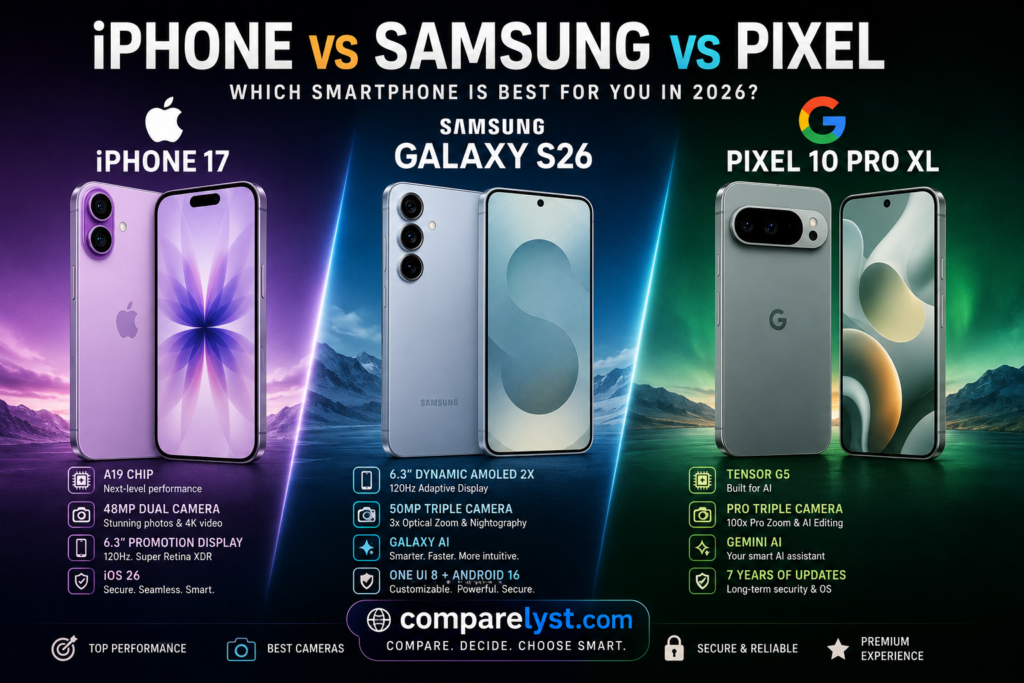
The iPhone 17 has the Apple A19 chip and Apple Intelligence. The 6.3-inch Super Retina XDR OLED display has ProMotion up to 120Hz refresh rate. In the camera department, the 48MP Dual Fusion system and 18MP Center Stage front camera are the main highlights.
The Samsung Galaxy S26 comes with a 6.3-inch Dynamic AMOLED 2X display, 120Hz adaptive refresh rate, 50MP main camera, 10MP telephoto camera and 12MP ultra-wide camera. Its weight of 167 grams is also an important advantage for compact flagship users.
The Google Pixel 10 Pro XL offers a large 6.8-inch LTPO OLED display, a Google Tensor G5 processor, 16GB of RAM, a 5,200mAh battery, and a Pro triple camera system. Google says it will offer seven years of OS, security, and Pixel Drop updates.
These three phones follow different philosophies. That’s why this comparison is interesting.
Design – iPhone 17, Galaxy S26 or Pixel 10 Pro XL?
While design is purely a personal preference, it matters in daily usage.
The iPhone 17 comes with an aluminum design, Ceramic Shield 2 front and a colour-infused glass back. It weighs 177 grams and is 7.95mm thick. Apple positions it as a compact flagship with a 6.3-inch display.
The design of the iPhone 17 is very clean and minimalistic. This design will give a familiar feel to those who love the Apple ecosystem. It is available in colors like Black, White, Mist Blue, Sage and Lavender.
The Samsung Galaxy S26 is even lighter. It weighs 167 grams and is 7.2mm thick. Despite the 6.3-inch display, it is comfortable to use in one hand due to its compact body.
The Samsung Galaxy S26’s design gives a modern Android flagship appearance due to the rounded edges and camera module arrangement.
The Pixel 10 Pro XL is in a completely different category. Its 6.8-inch display makes the body larger. Weight 232 grams and thickness 8.5mm.
So if portability is important, the Galaxy S26 and iPhone 17 are ahead. If a large display and media consumption are important, the Pixel 10 Pro XL is more attractive.
Design winner: Galaxy S26 – lightweight compact design
Display – whose screen is better?
All three phones have high-quality OLED displays. But their approaches differ.
The iPhone 17 has a 6.3-inch Super Retina XDR OLED display. Resolution 2622 × 1206 and 460ppi. ProMotion adaptive refresh rate goes up to 120Hz. Apple states that outdoor peak brightness goes up to 3,000 nits.
This makes scrolling, gaming and animations very smooth. Display visibility in outdoor sunlight is also strong.
The Samsung Galaxy S26 has a 6.3-inch Dynamic AMOLED 2X display. Resolution 2340 × 1080 and maximum 120Hz refresh rate. There is also Vision Booster technology.
Samsung displays are generally strong in delivering vibrant colors and deep blacks. The Galaxy S26 also has that experience.
The Pixel 10 Pro XL takes a different approach here. It has a 6.8-inch Super Actua LTPO OLED display. Resolution 1344 × 2992, 486ppi and 1–120Hz Smooth Display. Peak brightness goes up to 3,300 nits.
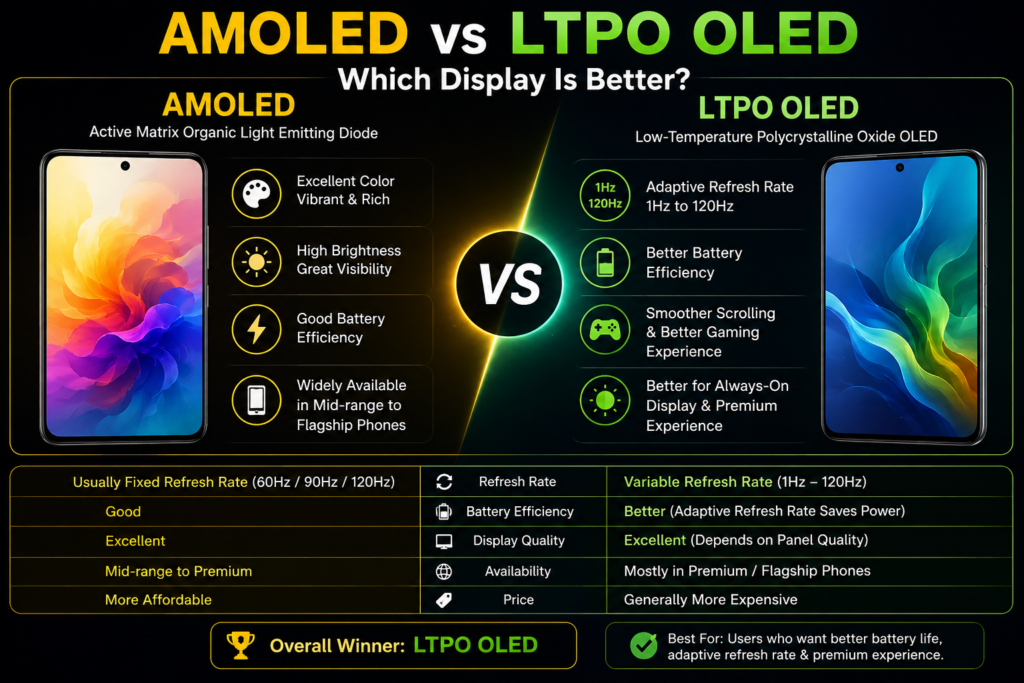
Thanks to LTPO technology, the refresh rate can be reduced and increased as needed. This can help with battery efficiency when watching static content.
The Pixel 10 Pro XL’s large 6.8-inch display is a big advantage for movies, YouTube, Netflix and reading.
But those who want a compact phone don’t need a 6.8-inch display.
Display winner: Pixel 10 Pro XL – large LTPO OLED experience
Performance – A19 vs Galaxy S26 processor vs Tensor G5
In a performance comparison, you need to look at real-world usage rather than just benchmark numbers.
The iPhone 17 has the A19 chip. It has a 6-core CPU, 5-core GPU with Neural Accelerators, and a 16-core Neural Engine. It also has hardware-accelerated ray tracing.
Since Apple designs its processor and operating system in a single ecosystem, performance is highly optimized.
The iPhone 17 offers a very smooth experience in tasks like opening apps, video editing, gaming, and everyday multitasking.
The processor type in the Galaxy S26 may vary depending on the market. According to Samsung India, the Snapdragon 8 Elite Gen 5 for Galaxy or Exynos 2600 configuration may be available in some markets.
Samsung optimizes the processor for Galaxy AI and demanding Android applications.
The Pixel 10 Pro XL has a Google Tensor G5 processor and Titan M2 security coprocessor. Google uses Tensor G5 mainly for AI and on-device experiences.
In normal daily usage, all three phones are fast.
When using apps like WhatsApp, Instagram, YouTube, Chrome, Gmail, and Google Maps, there is no big performance difference.
But in workloads like heavy gaming and professional video editing, the iPhone 17 and Galaxy S26 have a more raw performance-oriented approach. The Pixel’s strength is in AI-related tasks and Google software integration than in raw benchmark numbers.
Performance winner: iPhone 17 – overall performance consistency
Gaming – Which phone is best for gaming in 2026?
Processor alone is not enough for gaming. Display refresh rate, GPU performance, thermal management, battery efficiency, and game optimization are all important.
The iPhone 17’s A19 chip supports hardware-accelerated ray tracing. The 120Hz ProMotion display provides a smooth experience for gaming and scrolling.
Some games in the Apple ecosystem may get better optimization for hardware, which can provide a consistent experience.
The Galaxy S26 has a 120Hz Dynamic AMOLED 2X display and a flagship-class processor. The Android gaming ecosystem has a number of popular games available.
The Pixel 10 Pro XL has a Tensor G5 processor. But it’s not a gaming-first device like the other two phones, as Google’s focus is more on AI and camera processing.
If you’re into casual gaming, all three phones are sufficient.
But if long gaming sessions, demanding graphics, and maximum performance are important, the iPhone 17 or Galaxy S26 are safer choices.
Gaming winner: iPhone 17
Camera – iPhone vs Samsung vs Pixel
The camera is a very difficult category in this comparison.
Because all three brands approach camera processing differently.
The iPhone 17 has a 48MP Dual Fusion camera system. The main camera is a 48MP Fusion sensor. The Ultra Wide camera is also 48MP. Optical-quality 2x telephoto option is available through the main camera.
Apple’s camera processing includes features like Photonic Engine, Deep Fusion, Smart HDR 5, and next-generation portraits.
The Samsung Galaxy S26 has a 50MP wide camera, 12MP ultra-wide, and 10MP telephoto camera. The dedicated telephoto lens offers 3x optical zoom and up to 30x digital zoom.
This gives Samsung great flexibility in capturing portraits and distant subjects.
The Pixel 10 Pro XL has a 50MP wide, 48MP ultra-wide, and 48MP 5x telephoto camera system. Google Pro Zoom offers up to 100x.
The Pixel camera’s biggest strength is computational photography.
Google Tensor G5 and Google AI processing play a key role in the camera experience.
Google’s Camera Coach provides suggestions for composition and framing. Features like Magic Eraser, Best Take, Photo Unblur, and AI-based editing are also available.
iPhone 17 for natural-looking photos and reliable video
Galaxy S26 for versatile zoom and vibrant-looking images
Pixel 10 Pro XL for AI photography and computational editing
Camera winner: Pixel 10 Pro XL – photography features and AI flexibility
Portrait Photography
In portrait photography, you shouldn’t choose a phone based solely on background blur.
Skin tone, subject separation, edge detection, and lens perspective are important.
The iPhone 17 has next-generation portraits with Focus and Depth Control.
The Samsung Galaxy S26’s dedicated 3x telephoto lens helps give portrait photography a natural perspective.
The Pixel 10 Pro XL has a 5x telephoto lens and AI-based portrait processing. Google also offers High-Res Portrait Mode.
All three are good choices for portraits.
Pixel and Samsung are very useful if you want zoom portrait photography.
iPhone is very comfortable if you want a simple point-and-shoot portrait experience.
Portrait winner: Pixel 10 Pro XL – zoom + computational photography
Night Photography
Computational photography has become more important than sensor hardware in night photography.
The iPhone 17 has technologies like Night mode, Photonic Engine, and Deep Fusion.
Samsung Galaxy S26 improves low-light images and videos with ProVisual Engine and Nightography features.
Google’s computational photography is very important in the Pixel 10 Pro XL. Night Sight, Real Tone, Face Unblur and AI editing features are available.
Pixel is very strong in things like recovering details in dark scenes, controlling highlights and keeping faces natural.
Night photography winner: Pixel 10 Pro XL
Video Recording – Which phone is better for content creators?
iPhone is still very strong in video recording.
The iPhone 17 rear camera can record 4K Dolby Vision video up to 60fps. There are features like Cinematic mode, Action mode, stabilization, Spatial Audio and Audio Mix.
The front camera also has 4K Dolby Vision recording.
This makes the iPhone 17 a practical choice for YouTube creators, vloggers and Instagram creators.
Samsung India specifications state that the Samsung Galaxy S26 supports UHD 8K video recording up to 30fps.
Samsung’s camera processing and Nightography Video are useful for low-light video shooting.
The Pixel 10 Pro XL has features like Video Boost and AI-based video processing. Google emphasizes high-quality video and stabilization.
But the iPhone is more consistent in professional video workflow and social-media-ready video output.
Video winner: iPhone 17
Selfie Camera – Which front camera is better?
The iPhone 17 has an 18MP Center Stage front camera. It has features like Autofocus, Center Stage for photos and video calls, ultra-stabilized video, and Dual Capture.
Center Stage is particularly useful for video calls and group selfies.
The Samsung Galaxy S26 has a 12MP autofocus selfie camera.
The Pixel 10 Pro XL has a 42MP Dual PD autofocus selfie camera and a 103-degree ultra-wide field of view.
The Pixel is useful for group selfies and wider framing.
All three phones are good options for social media selfie users.
But for those who use front-camera features and video calls a lot, the iPhone 17 is a strong choice.
Selfie winner: iPhone 17
Battery – Which phone will last longer?
Battery life shouldn’t be judged by capacity alone.
The iPhone 17 is rated for up to 30 hours of video playback and up to 27 hours of streamed video playback, according to Apple official testing.
The Samsung Galaxy S26 has a 4,300mAh battery. Samsung claims up to 30 hours of video playback.
The Pixel 10 Pro XL has a 5,200mAh typical battery. Google claims 24+ hour battery life and up to 100 hours of battery life with Extreme Battery Saver.
The Pixel 10 Pro XL has the largest battery capacity of the three.
But with a larger display and 232-gram body, the Pixel can’t be called the automatic winner based on battery capacity alone.
The iPhone’s hardware-software optimization provides better battery efficiency.
Samsung offers a 4,300mAh battery in a compact body.
The Pixel has a larger battery and larger display combination.
Battery winner: Pixel 10 Pro XL – capacity advantage
Charging – Who charges faster?
Apple says the iPhone 17 can charge up to 50% in around 20 minutes using a 40W adapter or higher. It supports MagSafe wireless charging up to 25W and Qi2 up to 25W.
Google says the Pixel 10 Pro XL can charge up to 70% in around 30 minutes using a 45W USB-C PPS charger or higher. It also supports Qi2 wireless charging up to 25W.
Galaxy S26 charging speed may vary based on regional configuration and charger.
All three are good options when it comes to charging convenience.
Charging winner: Pixel 10 Pro XL – fast wired charging advantage
AI Features – Apple vs Samsung vs Google
It’s hard to imagine a flagship smartphone in 2026 without AI.
Apple Intelligence is integrated into the iPhone 17. Apple Intelligence helps with communication, writing, Siri, and other everyday tasks.
Apple’s AI approach focuses on privacy and ecosystem integration.
Galaxy AI is a big selling point in the Samsung Galaxy S26.
Samsung’s new AI features understand the context of the screen and provide suggestions. Features like Photo Assist help with photo editing using natural-language instructions.
Google’s Pixel 10 Pro XL’s AI experience is even deeper.
Tensor G5 and Gemini Nano are used for on-device AI experiences. Magic Cue, Camera Coach, and Gemini-related features are integrated into the Pixel experience.
AI experiences like giving natural-language instructions for photo editing, such as “Remove glare from this photo,” are a big strength of the Pixel.
It’s also worth noting that AI features may vary by country, language, and software version.
AI winner: Pixel 10 Pro XL
Software Experience
iPhone 17 comes with iOS 26. iOS’s biggest advantage is consistency and Apple ecosystem integration.
iPhone is very convenient for those who use MacBook, iPad, Apple Watch or AirPods.
Samsung Galaxy S26 offers Android and Samsung One UI experience.
Customization, multitasking and Android ecosystem flexibility are the strengths of Galaxy S26.
Google Pixel 10 Pro XL launched with Android 16. Google offers seven years of OS, security and Pixel Drop updates.
Pixel users have direct access to Google’s Android experience and AI features.
iPhone for those who want a simple and controlled interface.
Samsung for those who want customization.
Pixel for those who want clean Android + AI.
Software winner: Personal preference
Long-Term Updates – Who is future-proof?
When buying a flagship phone, it is also important to consider how the software support will be after two or three years.
Google Pixel 10 Pro XL is officially listed as getting seven years of OS, security, and Pixel Drop updates.
Apple has a long-standing reputation for providing software updates to iPhone models for years.
Samsung also follows a long software support strategy for its recent flagship devices.
So all three brands are strong for long-term usage.
But the exact update duration and feature availability may vary based on country and model. It is best to check the official support policy when buying a phone.
Long-term software winner: Pixel 10 Pro XL – clear seven-year policy
Which Phone Is Best for Students?
When buying a phone for students, the camera is not the only thing that matters.
Battery, performance, storage, portability, and price are also important.
iPhone 17 is a good choice for notes, video calls, content creation, and gaming.
Galaxy S26 is lightweight, making it comfortable for college users.
Pixel 10 Pro XL is useful for reading, PDFs, videos, and AI-based productivity due to its large screen.
But it is not a compact phone due to its 232 grams weight.
If portability is important for students, then the Galaxy S26.
If content creation is important, then the iPhone 17.
If reading and AI productivity are important, then the Pixel 10 Pro XL.
Which Phone Is Best for Content Creators?
Camera quality alone is not enough for a content creator.
Video stabilization, front camera, audio, editing, storage, and social media compatibility are important.
The iPhone 17 is very balanced in this category.
Features like 4K Dolby Vision, Cinematic mode, Action mode, Center Stage, and Audio Mix are useful for creators.
The Samsung Galaxy S26 is useful for travel creators due to its zoom and versatile camera system.
The Pixel 10 Pro XL is attractive to photo creators due to its AI editing and computational photography.
Content creator winner: iPhone 17
Which Phone Is Best for Photography?
It’s hard to choose a single winner for photography.
The iPhone 17 offers balanced colors and consistent processing.
The Samsung Galaxy S26 offers dedicated telephoto and 3x optical zoom.
The Pixel 10 Pro XL offers a 50MP + 48MP ultra-wide + 48MP 5x telephoto setup and AI-based editing. Pro Zoom goes up to 100x.
If you’re serious about photography, the Pixel 10 Pro XL is a great option.
Photography winner: Pixel 10 Pro XL
Which Phone Is Best for Everyday Use?
Lightweight and comfortable design is important for everyday use.
The Galaxy S26 is very comfortable in this category because it weighs 167 grams.
The iPhone 17 is 177 grams.
The Pixel 10 Pro XL is 232 grams.
So for one-handed use, calls, and social media scrolling, the Galaxy S26 is practical.
Pixel for large-screen media consumption.
iPhone for balanced premium experience.
Everyday comfort winner: Samsung Galaxy S26
Which is the Overall Best Smartphone in 2026?
Now the final question.
iPhone 17 vs Samsung Galaxy S26 vs Google Pixel 10 Pro XL – Who is the overall winner?
All three phones are strong in different areas.
The iPhone 17’s biggest strengths are performance, video recording, front camera, ecosystem and consistent software experience.
The Samsung Galaxy S26’s biggest strengths are lightweight design, AMOLED display, telephoto camera, compact form factor and Galaxy AI.
The Google Pixel 10 Pro XL’s biggest strengths are camera system, AI, large LTPO display, battery capacity and long-term software support.
So, instead of saying a single overall winner, it is practical to choose based on usage.
If performance and gaming are important – iPhone 17
If video and content creation are important – iPhone 17
If you want a compact and lightweight flagship – Samsung Galaxy S26
If zoom photography is important – Pixel 10 Pro XL
If AI features are important – Pixel 10 Pro XL
If you want the Samsung ecosystem – Galaxy S26
If you are using the Apple ecosystem – iPhone 17
If you want a large display – Pixel 10 Pro XL
If long-term official update commitment is important – Pixel 10 Pro XL
Final Verdict – Best Smartphone 2026
Giving the title of “Best Smartphone” to a single phone in 2026 is not the right approach.
The phone that suits your needs is the real best smartphone.
iPhone 17 is a balanced flagship. Its major strengths are the A19 chip, 120Hz ProMotion display, 48MP Dual Fusion camera, advanced video recording and Apple ecosystem.
Samsung Galaxy S26 compact Android flagship. Its major advantages are its 167-gram body, 6.3-inch Dynamic AMOLED 2X display, 50MP main camera, 3x optical telephoto and Galaxy AI.
Google Pixel 10 Pro XL AI and photography-focused flagship. 6.8-inch LTPO OLED display, Tensor G5, 16GB RAM, 5,200mAh battery, triple camera system, 100x Pro Zoom and seven years of updates set it apart.
If you value performance + gaming + video, the iPhone 17 is a strong choice.
If you want compact design + Samsung ecosystem + zoom, the Galaxy S26 is a good choice.
If you want camera + AI + large display + long-term updates, the Pixel 10 Pro XL is very attractive.
Ultimately, when buying a smartphone, you should ask yourself “Which phone is more useful for my daily usage?” rather than “Which phone has more specifications?”
One person may not need the best camera phone for another. Another person may need the iOS ecosystem. For others, Android customization may be important. So choosing a flagship phone is not just a specification race; it is a decision based on personal preference and usage pattern.
In 2026, whichever of these three phones you choose will provide a premium smartphone experience. But keeping your priorities clear will reduce the chances of buying the wrong phone.
The best way to choose a phone that suits your budget and needs is to compare real-world factors such as camera, display, performance, battery, AI and everyday usage on smartphone comparison platforms like Comparelyst.com, rather than just looking at specifications.
Frequently Asked Questions
- What is the overall best smartphone in 2026?
There is no single overall winner. If performance and video are important, go for the iPhone 17. If you want a compact Android experience and zoom, go for the Galaxy S26. If camera, AI and a large display are important, go for the Pixel 10 Pro XL.
2. iPhone 17 or Samsung Galaxy S26 – which is better?
iPhone 17 is strong in performance, video and the Apple ecosystem. Galaxy S26 is strong in lightweight design, telephoto camera, Android customization and Galaxy AI.
3. Why is the Pixel 10 Pro XL special?
The Pixel 10 Pro XL has a 6.8-inch LTPO OLED display, Tensor G5 processor, 16GB RAM, 5,200mAh battery, triple rear camera and AI-powered photography features.
4. Which phone is better for camera?
The Pixel 10 Pro XL is a very strong choice due to its camera hardware and AI photography features. The Samsung Galaxy S26’s 3x telephoto and the iPhone 17’s consistent photo/video processing are also excellent alternatives.
5. Which phone is better for gaming?
The iPhone 17 is a strong choice for gaming due to the A19 chip and hardware-accelerated ray tracing. The Galaxy S26 also offers flagship-level Android gaming performance.
6. Which phone is better for AI features?
The Pixel 10 Pro XL has AI features like Tensor G5, Gemini Nano, Magic Cue, and Camera Coach, making it very strong in the AI experience.
7. Is the Pixel good for long-term usage?
Yes. Google states that the Google Pixel 10 Pro XL will get seven years of OS, security, and Pixel Drop updates.
8. Which is the lightweight phone?
Of the three, the Samsung Galaxy S26 is the most lightweight. Its weight is 167 grams. iPhone 17 is 177 grams, Pixel 10 Pro XL is 232 grams.
9. Which phone if you want a large display?
The Pixel 10 Pro XL has a 6.8-inch Super Actua LTPO OLED display. The iPhone 17 and Galaxy S26 both have 6.3-inch displays.
10. Which phone should content creators buy?
If video recording, stabilization, and front-camera features are important, the iPhone 17 is a very balanced choice. Those who are into photography and AI editing should consider the Pixel 10 Pro XL.
You can compare smartphone specifications and features on Comparelyst.com and choose the phone that suits your usage.
Disclosure: As an Amazon Associate, Comparelyst earns from qualifying purchases.