iPhone 17 vs Samsung Galaxy S26 – Which is the Best Flagship Phone in 2026?
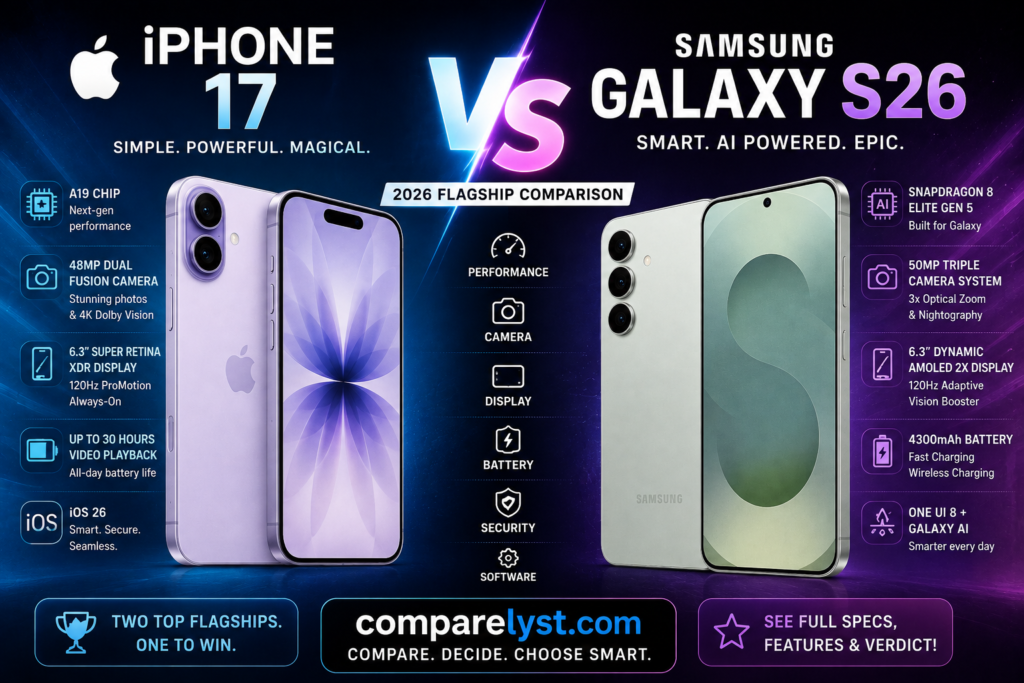
The iPhone 17 vs Samsung Galaxy S26 comparison is quite interesting when you are thinking of buying a premium smartphone in 2026. Although both phones are in the flagship category, the way Apple and Samsung approach the smartphone experience is different. In the iPhone 17, Apple focuses on its A19 chip, 120Hz ProMotion display, improved camera system, Apple Intelligence and iOS 26 experience. The Samsung Galaxy S26, on the other hand, focuses on a compact flagship design, Dynamic AMOLED 2X display, Galaxy AI, versatile camera setup and Android ecosystem.
When choosing a smartphone, deciding on the processor or camera megapixels alone is not the right approach. What matters is how we use the phone on a daily basis. For some, the camera and video may be important. For others, gaming may be important. For some, the compact design may be a must. For others, the compact design may be a must. For others, the customization of Android and the Galaxy AI features may be a must.
So in this article, we will take a detailed look at the two phones, iPhone 17 and Samsung Galaxy S26, in important areas such as design, display, performance, gaming, camera, video, selfie, battery, charging, software, AI, security, connectivity and everyday usage.
iPhone 17 vs Samsung Galaxy S26 – How is the design?
First, let’s look at the design of the two phones.
The iPhone 17 uses an aluminum design. There is Ceramic Shield 2 on the front and a colour-infused glass back. According to Apple specifications, the iPhone 17 has a height of 149.6mm, width 71.5mm and thickness 7.95mm. Its weight is 177 grams.
This weight is very comfortable for a flagship smartphone. It is comparatively easy to use the iPhone 17 in one hand, especially compared to the larger Pro Max type phones. The weight of 177 grams is an advantage in everyday usage such as walking with it in your pocket, using social media for a long time or making calls.
The design of the Samsung Galaxy S26 also follows a compact flagship approach. According to Samsung specifications, the Galaxy S26 is 7.2mm thick and weighs 167 grams. Its display is 6.3-inches.
This makes both the Galaxy S26 and the iPhone 17 a compact premium experience as an alternative to larger flagship phones.
Samsung India states that the Samsung Galaxy S26 is available in color options such as Cobalt Violet, Sky Blue, Black and White. Availability may vary depending on the market.
The iPhone 17 is available in finishes such as Black, White, Mist Blue, Sage and Lavender.
In terms of design, both phones are premium.
The design of the iPhone 17 gives a simple and minimalistic feel. The Samsung Galaxy S26 maintains the modern Android flagship identity.
If using the phone in one hand is important to you, both phones are good choices.
In weight, the iPhone 17 is slightly heavier. But since the difference is only 10 grams, it will not be a huge difference in real-world usage.
Design winner: Tie – personal preference
Display – iPhone 17 vs Galaxy S26
The display is one of the most important parts of these two phones.
The iPhone 17 has a 6.3-inch Super Retina XDR OLED display. Resolution 2622 × 1206 pixels and 460 ppi. Apple has brought ProMotion technology to the iPhone 17 in this generation. Adaptive refresh rate goes up to 120Hz. There is Always-On display, HDR, True Tone and P3 wide color support.
This is a significant upgrade.
Scrolling, animations and compatible games look very smooth due to the 120Hz refresh rate. Previously, there was a big difference in display refresh rate between standard iPhone models and Pro models. Now that gap has been reduced with ProMotion on the iPhone 17.
The iPhone 17 is also strong in outdoor usage. According to Apple specifications, outdoor peak brightness goes up to 3,000 nits. The ability to reduce the minimum brightness to 1 nit is also useful for night-time usage.
The Samsung Galaxy S26 has a 6.3-inch Dynamic AMOLED 2X display. The resolution is FHD+ 2340 × 1080 pixels and the maximum refresh rate is 120Hz. It also uses Samsung Vision Booster technology.
The Galaxy S26 display offers deep blacks and strong contrast thanks to its AMOLED technology.
Samsung displays are generally known for their vibrant colors and excellent viewing experience. That experience continues with the Galaxy S26.
In the resolution comparison here, both phones offer practical everyday sharpness in the FHD+/high-resolution class. The iPhone 17’s 460 ppi density is very sharp. The Samsung Galaxy S26’s display is also sufficiently sharp for everyday use.
The 120Hz refresh rate on both phones ensures a smooth scrolling experience.
Both screens are excellent when watching movies, YouTube, and social media.
It’s hard to pick a clear winner in display quality.
iPhone 17’s ProMotion and 3,000-nit outdoor peak brightness are strong.
Samsung Galaxy S26’s Dynamic AMOLED 2X and Vision Booster are strong.
Display winner: Tie
Performance – A19 vs Galaxy S26 Processor
Performance is a very important factor when buying a flagship phone.
The iPhone 17 has the Apple A19 chip. It has a 6-core CPU, 5-core GPU with Neural Accelerators, and a 16-core Neural Engine. There is also hardware-accelerated ray tracing support.
Apple optimizes both its chip and operating system together, so real-world performance is very smooth.
The A19 delivers strong performance in tasks like opening apps, multitasking, photo editing, video processing, and gaming.
The Samsung Galaxy S26’s processor may vary depending on the market. According to Samsung India information, the Galaxy S26 series uses a customized processor; Samsung offers Snapdragon 8 Elite Gen 5 for Galaxy in some markets and Exynos 2600 configurations in some markets.
Due to this regional difference, it is important to check the exact variant and processor available in India when buying the Galaxy S26.
Samsung states that its customized processor has improved CPU, GPU and NPU performance. The processor also plays a key role in efficiently running Galaxy AI features on the phone.
Both phones are fast in normal daily usage.
The performance difference is not much noticeable when using apps like WhatsApp, Instagram, YouTube, Chrome, Google Maps, banking apps and email.
The processor difference may be more noticeable in heavy gaming, video editing and demanding AI tasks.
The hardware-software integration of the A19 is an advantage for the iPhone.
Samsung’s customized processor and Galaxy AI optimization are an advantage for the Galaxy S26.
Performance winner: Tie – usage dependent
Gaming – iPhone 17 or Galaxy S26?
Just having a 120Hz display is not enough for gaming.
Processor, GPU, thermal management, touch response, battery efficiency and game optimization all together determine the gaming experience.
iPhone 17 has an A19 chip and hardware-accelerated ray tracing.
Graphics performance is strong in high-end games.
Some games and titles in the Apple ecosystem are specifically optimized for the hardware, so you can get a consistent gaming experience.
Samsung Galaxy S26 also has a powerful customized processor. Samsung has emphasized performance and smooth visuals. Galaxy S26 display supports 120Hz refresh rate.
Battery drain and heat management are important during long gaming sessions.
Both phones will provide sufficient performance for casual gaming users.
But if you are serious about mobile gaming and play graphics-intensive games, it is a good idea to check the Galaxy S26 processor variant available in your region and the optimization for those specific games before buying.
The iPhone 17 is a strong gaming phone due to its A19 performance and game optimization.
Gaming winner: iPhone 17 – slight advantage
Camera – iPhone 17 vs Samsung Galaxy S26
The camera comparison is very interesting.
The iPhone 17 has a 48MP Dual Fusion camera system. The main camera is a 48MP Fusion sensor. It is accompanied by a 48MP Fusion Ultra Wide camera. The main camera supports sensor-shift optical image stabilization.
The iPhone 17 main camera can capture 48MP high-resolution photos. The Ultra Wide camera also has a 48MP resolution, which provides good flexibility for landscape and group photography.
Apple camera processing includes features such as Photonic Engine, Deep Fusion, Smart HDR 5 and latest-generation Photographic Styles.
Thus, the main strength of the iPhone 17 camera is consistency.
It is important to balance colors, exposure, skin tones and HDR processing when taking a photo.
The Samsung Galaxy S26 has a 50MP wide camera, 12MP ultra-wide camera and 10MP telephoto camera. It supports 3x optical zoom and 2x optical-quality zoom. Digital zoom is up to 30x.
Therefore, having a dedicated telephoto lens in the Samsung camera system is a major advantage.
Optical zoom is useful when doing portrait photography and capturing distant subjects.
Samsung ProVisual Engine and AI-powered image processing improve details and low-light performance in photos and videos. The Samsung Galaxy S26 series highlights features like Nightography video and AI photo editing.
The two phones have different approaches to camera hardware.
The iPhone 17 has both the main and ultra-wide 48MP.
The Samsung has a main camera of 50MP and a dedicated 3x telephoto.
If you like landscape and ultra-wide photography, the iPhone 17 is interesting.
If you like portraits, zoom, and capturing distant subjects, the Galaxy S26 is useful.
Camera winner: Samsung Galaxy S26 – versatility advantage
Portrait Photography
Background blur is not the only thing that matters when taking portrait photos.
Subject separation, skin tones, hair details, exposure, and edge detection are also important.
The iPhone 17 has next-generation portraits with Focus and Depth Control. Features like Portrait Lighting and Photographic Styles are also available.
This gives the user the flexibility to do post-processing on portrait photos.
The Samsung Galaxy S26 has a dedicated 3x telephoto camera, which is useful for portrait photography.
When using 3x optical zoom, the subject can be captured in a natural perspective.
Both phones can deliver good results in portrait photography.
The iPhone’s skin tone consistency and the Samsung’s telephoto flexibility both have their own advantages.
Portrait winner: Tie
Night Photography – Night time camera performance
Software processing is very important in low-light photography.
The iPhone 17 has computational photography features like Night mode, Photonic Engine, Deep Fusion, and Smart HDR 5.
Apple uses image processing to balance details and exposure in dark environments.
The Samsung Galaxy S26 has ProVisual Engine and Nightography features. Samsung uses AI-driven image processing to improve details and noise control in dark scenes. The Nightography Video feature is also a major highlight in the series.
In night photography, Samsung’s processing may give some users a more vibrant output.
The iPhone is strong in providing natural-looking output and consistent exposure.
Lighting conditions and personal preference are important when it comes to which phone is better.
If you like natural colors, go for the iPhone.
If you like brighter-looking night photos, go for the Samsung.
Night photography winner: Tie
Video Recording – iPhone 17 vs Galaxy S26
The iPhone 17 is very strong in video recording.
The iPhone 17 rear camera can record 4K Dolby Vision video at 24fps, 25fps, 30fps and 60fps. Cinematic mode up to 4K Dolby Vision at 30fps and Action mode up to 2.8K Dolby Vision at 60fps are available.
Features like video stabilization, continuous autofocus, Audio Mix and wind-noise reduction are useful for creators.
The front camera also supports 4K Dolby Vision recording.
This makes the iPhone 17 a strong option for YouTube creators, Instagram creators and vloggers.
The Samsung Galaxy S26 also has advanced video processing and Nightography Video. Samsung is trying to improve low-light video quality through AI-powered image processing.
The Galaxy S26 camera system has OIS and telephoto flexibility, which is useful for different shooting situations.
But for professional video workflow and consistent video output, the iPhone is generally more creator-friendly.
Video winner: iPhone 17
Selfie Camera – Which phone is better?
The iPhone 17 has an 18MP Center Stage front camera. It has features like Autofocus, Focus Pixels, Center Stage for photos and video calls, ultra-stabilized video, and Dual Capture. It also supports 4K Dolby Vision front-camera recording.
Center Stage is especially useful for video calls.
The camera automatically helps keep the subject in the frame even if you move in the frame.
The Samsung Galaxy S26 has a 12MP front camera. It supports Autofocus.
Samsung selfie processing gives good results in skin tones and details.
But the iPhone 17 is more attractive to creators and video-call users due to the front camera resolution and advanced Center Stage features.
Selfie winner: iPhone 17
Battery Life – iPhone 17 vs Galaxy S26
You shouldn’t just look at the raw mAh number in a battery comparison.
Apple uses a lithium-ion battery in the iPhone 17. Apple specifications provide up to 30 hours of video playback and up to 27 hours of streamed video playback.
When using a 40W adapter or higher, you can charge up to 50% in around 20 minutes. Apple states that using a 30W adapter or higher with a MagSafe Charger can charge up to 50% in around 30 minutes.
Samsung India states that the Samsung Galaxy S26 has a 4,300mAh battery.
Samsung has tried to balance the battery performance of the Galaxy S26 series with a compact design.
According to Samsung official information, the Galaxy S26 video playback battery life can be up to 30 hours.
Thus, both the phones are competitive in battery endurance.
Actual battery life will vary depending on brightness, mobile network, 5G usage, camera usage, gaming and background apps.
If you are a heavy gaming user, battery performance may differ in practical usage.
Both phones are designed to comfortably handle a day’s worth of usage for normal social media, browsing, calls, and video streaming users.
Battery winner: Tie
Charging – Who charges faster?
Charging speed is now a major factor when buying a smartphone.
The iPhone 17 can charge up to 50% in 20 minutes with a 40W adapter or higher. It supports MagSafe wireless charging up to 25W and Qi2 wireless charging up to 25W.
The charging capabilities of the Samsung Galaxy S26 may vary depending on the market and charger configuration. The Galaxy S26 series focuses on compact design and all-day battery experience.
Both Samsung and Apple are mature in the wireless charging ecosystem.
If you use wireless charging accessories a lot, both platforms have good options.
If charging speed is your only priority, you should check the exact regional charger specifications and in-box charger availability before buying.
Charging winner: iPhone 17
Software – iOS 26 vs One UI
Software is the biggest differentiator between the two phones.
The iPhone 17 comes with iOS 26. Apple tightly integrates its operating system with its hardware.
iOS’s biggest advantage is its simplicity and ecosystem.
The iPhone experience is very convenient for those who use a MacBook, iPad, Apple Watch, or AirPods.
Photos, messages, calls, and other Apple services work seamlessly between devices, which is a big advantage for ecosystem users.
The Samsung Galaxy S26 offers an Android-based One UI experience.
The Samsung ecosystem includes features like Galaxy Buds, Galaxy Watch, Galaxy Tab, and Windows integration.
One UI offers more flexibility in customization and multitasking options.
Android users have more home screen customization, widgets, file management, and app-level flexibility.
iOS is a relatively controlled environment.
Android is a comparatively open environment.
So the software winner is a matter of personal preference.
If you already use the Apple ecosystem, go for the iPhone 17.
If you like Android customization and the Samsung ecosystem, go for the Galaxy S26.
Software winner: Tie – ecosystem preference
AI Features – Apple Intelligence vs Galaxy AI
AI has become important in the 2026 smartphone experience.
The iPhone 17 has Apple Intelligence integrated. Apple uses it in many areas such as communication, writing, Siri and everyday tasks.
Apple Intelligence’s key selling point is privacy.
Apple emphasizes privacy protections in its AI experience.
Galaxy AI is a key feature in the Samsung Galaxy S26.
The Samsung Galaxy S26 series understands the context of what is happening on the screen through features like Now Nudge and provides suggestions. Photo Assist allows you to edit photos using natural-language prompts.
Samsung AI’s advantage is deeper integration into the Android ecosystem.
For example, when editing a photo, you can tell AI what to change in natural language and do the editing.
Samsung Galaxy S26 is interesting for those who want to do more AI with productivity, communication and photo editing.
Both Apple Intelligence and Galaxy AI are useful.
But AI features may vary depending on country, language and software version.
AI winner: Samsung Galaxy S26 – feature variety advantage
Storage – iPhone 17 vs Galaxy S26
The iPhone 17 is available in 256GB and 512GB storage options.
This is a good starting storage for users.
256GB is very practical for those who have a lot of 4K videos, photos, games and apps.
The Samsung Galaxy S26 is available in 256GB and 512GB storage configurations as per the India specifications. 12GB RAM configurations are also mentioned. Availability may vary depending on the market and carrier.
Both the phones offer similar options in terms of storage.
However, there are differences in both the cloud ecosystem and file management.
iPhone users can use the iCloud ecosystem.
Samsung users can use Google Drive, Samsung Cloud-related services and Android file management options.
Storage winner: Tie
Security and Privacy
Both Apple and Samsung are strong in the security area.
The iPhone 17 has Face ID. Apple considers privacy to be an important part of the iPhone experience. Apps have to ask permission to track users. Services like iMessage and FaceTime offer end-to-end encryption.
The Samsung Galaxy S26 also has a strong security architecture.
Device and data protection is emphasized through Galaxy AI and the Samsung Knox ecosystem.
Biometric authentication, secure folders, and Samsung security features are useful for Android users.
Apple has a more straightforward approach to privacy.
Samsung offers security features with Android flexibility.
Security winner: Tie
Water and Dust Resistance
The iPhone 17 has an IP68 rating. Apple testing conditions specify water resistance up to 6 meters deep for up to 30 minutes.
The Samsung Galaxy S26 also has IP68 water and dust resistance. Samsung testing conditions specify protection up to 1.5 meters of freshwater for up to 30 minutes. Samsung also notes that water resistance is not permanent and may decrease over time due to normal wear and tear.
This means that both phones offer good protection in situations like rain, accidental splashes, or daily outdoor use.
But just because it’s water-resistant doesn’t mean it’s safe to intentionally use the phone in a swimming pool or sea water.
Durability winner: Tie
Connectivity – 5G, Wi-Fi and Bluetooth
The iPhone 17 has 5G, Wi-Fi 7 and Bluetooth 6 support. It also has the Apple N1 wireless networking chip.
The Samsung Galaxy S26 also has modern 5G connectivity and advanced wireless standards.
Both phones are future-ready for fast Wi-Fi, Bluetooth accessories and 5G networks.
Carrier compatibility is important in markets like India.
It’s a good idea to check your SIM provider’s 5G band support and exact regional model compatibility before buying a phone.
Connectivity winner: Tie
Everyday Usage – Which phone is more comfortable?
A phone is not used just for benchmark scores.
From turning off the alarm in the morning to watching YouTube at night, the phone is our daily companion.
In this usage, the compact size is an advantage for both phones.
iPhone 17 177 grams.
Galaxy S26 167 grams.
So the Galaxy S26 is about 10 grams lighter.
A lighter phone may be more comfortable for some users when doing long reading sessions or social media scrolling.
iPhone 17’s iOS interface is simple.
Samsung Galaxy S26’s One UI offers more customization and AI features.
If someone who already uses the iPhone ecosystem picks up the iPhone 17, there is no need to transition.
Android user picks up the Samsung Galaxy S26, you will get a familiar ecosystem.
Everyday comfort winner: Samsung Galaxy S26 – lighter design
Which phone is best for content creators?
Content creation is not just about the camera.
Video quality, stabilization, audio, editing, file transfer and social media compatibility are important.
The iPhone 17 has features like 4K Dolby Vision video recording, Cinematic mode, Action mode, Dual Capture and advanced stabilization.
The front camera also supports 4K Dolby Vision recording, which is useful for vloggers and creators.
The Samsung Galaxy S26 also has advanced video processing and Nightography Video. AI processing helps improve details and clarity in low-light video.
But the iPhone 17 is very strong in professional video workflow and consistent video output.
The iPhone is a safe choice for those who create Instagram Reels, YouTube Shorts and YouTube videos.
Creator winner: iPhone 17
Who can buy the iPhone 17?
The iPhone 17 is a good choice for you, if you are using the Apple ecosystem.
If you already have a MacBook, iPad, Apple Watch or AirPods, the ecosystem integration is very useful.
If camera and video recording are important to you, the iPhone 17 is strong.
4K Dolby Vision recording, Center Stage camera, A19 chip and 120Hz ProMotion display provide an everyday premium experience.
The iPhone 17 is also practical for those who want a simple software experience and long-term iOS usage.
If you want a compact Apple flagship, the iPhone 17 is very attractive.
Who should buy the Samsung Galaxy S26?
The Samsung Galaxy S26 is a good choice for you, if you are in the Android ecosystem.
Galaxy AI features, 3x optical telephoto camera, Dynamic AMOLED 2X display and compact 167-gram design are its main strengths.
One UI is useful for those who want Android customization.
If you already use devices like Samsung Galaxy Watch or Galaxy Buds, you will get an ecosystem advantage.
The Galaxy S26 is also attractive for those who use zoom photography and AI features a lot.
iPhone 17 vs Samsung Galaxy S26 – Which is better in 2026?
Now let’s get to the important question.
iPhone 17 or Samsung Galaxy S26 – Which should you buy?
Both phones offer a flagship-level experience.
The biggest strengths of the iPhone 17 are the A19 chip, 120Hz ProMotion display, 48MP Dual Fusion camera system, advanced video recording, 18MP Center Stage camera and the Apple ecosystem.
The biggest strengths of the Samsung Galaxy S26 are the compact 167-gram design, Dynamic AMOLED 2X display, 50MP main camera, 3x optical telephoto, Galaxy AI and Android customization.
If you do a lot of video recording and content creation, the iPhone 17 is the best choice.
If you use zoom photography and AI features a lot, the Galaxy S26 is the best choice.
If you use the Apple ecosystem, the iPhone 17.
If you use Android and the Samsung ecosystem, the Galaxy S26.
If you want a lighter phone, the Galaxy S26.
If you want Face ID and the iOS experience, go for the iPhone 17.
If you want customization and Galaxy AI, go for the Samsung Galaxy S26.
If you want professional-looking video, go for the iPhone 17.
If you want telephoto portraits and zoom, go for the Galaxy S26.
Final Verdict
All things considered, the iPhone 17 vs Samsung Galaxy S26 isn’t a simple winner-take-all comparison.
Both phones are great for different users.
The iPhone 17 is a balanced Apple flagship. Its A19 chip, 120Hz ProMotion display, 48MP dual camera setup, 4K Dolby Vision video, 18MP Center Stage camera, and iOS 26 experience make it a complete smartphone.
The Samsung Galaxy S26 is a compact Android flagship. Its 167-gram design, 6.3-inch Dynamic AMOLED 2X display, 50MP main camera, 3x optical telephoto, Galaxy AI, and Android ecosystem make it stand out.
So, you can decide based on your priorities.
Performance + Video + Apple Ecosystem → iPhone 17
Zoom + AI + Android Customization → Samsung Galaxy S26
Content Creation → iPhone 17
Compact Android Experience → Galaxy S26
Telephoto Photography → Galaxy S26
Gaming → iPhone 17
AI Features → Galaxy S26
Software Simplicity → iPhone 17
Customization → Galaxy S26
Ultimately, the question is not “Which phone has the best specs?”
“Which phone is more useful for my daily usage?”
On that basis, both the iPhone 17 and Samsung Galaxy S26 are premium compact flagship phones to consider in 2026.
If camera, video, performance, and the Apple ecosystem are important to you, the iPhone 17 is a strong choice.
If AI, zoom photography, customization, and the Samsung ecosystem are important to you, the Galaxy S26 is a strong choice.
Frequently Asked Questions
- iPhone 17 vs Samsung Galaxy S26 – Which is the overall best?
Overall, there is no single winner for all users. If video, performance and Apple ecosystem are important, then iPhone 17. If AI, zoom photography and Android customization are important, then Galaxy S26.
2. Does iPhone 17 have a 120Hz display?
Yes. iPhone 17 supports adaptive refresh rate up to 120Hz through ProMotion technology. This is one of the important display upgrades of iPhone 17.
3. Does Samsung Galaxy S26 have a 120Hz display?
Yes. Galaxy S26 Dynamic AMOLED 2X display supports maximum 120Hz adaptive refresh rate.
4. Is iPhone 17 camera good?
Yes. iPhone 17 has 48MP Fusion Main and 48MP Fusion Ultra Wide camera system. Features like Night mode, Smart HDR 5, Photonic Engine and 48MP macro photography are available.
5. Is Galaxy S26 camera good?
Yes. The Galaxy S26 has a 50MP main, 12MP ultra-wide and 10MP telephoto camera system. It supports 3x optical zoom and up to 30x digital zoom.
6. Which phone is better for zoom photography?
The Galaxy S26 has a dedicated 10MP telephoto camera and 3x optical zoom, which gives it an advantage in zoom and portrait photography.
7. Is the iPhone 17 good for video recording?
Yes. With features like 4K Dolby Vision recording up to 60fps, Cinematic mode, Action mode and advanced stabilization, the iPhone 17 is a strong option for content creators.
8. How is the iPhone 17 battery life?
According to Apple specifications, the iPhone 17 offers up to 30 hours of video playback and up to 27 hours of streamed video playback. Actual battery life will vary depending on usage.
9. How much is the Galaxy S26 battery?
According to Samsung India specifications, the Galaxy S26 has a 4,300mAh battery.
10. Does the Galaxy S26 have Galaxy AI?
Yes. The Galaxy S26 series has Galaxy AI features. Samsung has tried to simplify daily tasks and photo editing with AI through features like Now Nudge and Photo Assist.
11. Does the iPhone 17 have Apple Intelligence?
Yes. The iPhone 17 has Apple Intelligence integrated. Feature availability may vary depending on language, region, and software version.
12. iPhone 17 or Galaxy S26 for gaming?
Both phones are powerful. The iPhone 17’s A19 chip and hardware-accelerated ray tracing are strong for gaming. The Galaxy S26’s customized processor and 120Hz display also provide a smooth gaming experience.
13. Are the iPhone 17 and Galaxy S26 water resistant?
Yes. Both phones have an IP68 rating. But water resistance is not permanent; intentional underwater usage is not recommended.
Conclusion
iPhone 17 vs Samsung Galaxy S26 is a very interesting comparison in the compact flagship segment in 2026.
iPhone 17 is strong in performance, video recording, selfie camera and Apple ecosystem.
Samsung Galaxy S26 is strong in compact design, telephoto photography, Galaxy AI and Android customization.
Therefore, it is best to choose a phone by understanding your needs first.
Don’t just decide on a phone’s megapixel, processor name or refresh rate, but also consider the camera, battery, software, ecosystem, daily comfort and long-term usage.
In that way, both iPhone 17 and Samsung Galaxy S26 are strong choices for users looking to buy a premium smartphone in 2026.
You can easily find the information you need to choose your next smartphone through such smartphone comparisons, camera guides, display comparisons, performance articles and mobile technology information on Comparelyst.com.
Disclosure: As an Amazon Associate, Comparelyst earns from qualifying purchases.