Top 7 Phones That Give the iPhone a Real Fight in 2026
The smartphone market in 2026 has become more competitive than ever. A few years ago, many people thought that a premium smartphone was the iPhone. But now that situation is changing. Brands like Samsung, Google, OnePlus, Xiaomi, Vivo, and Oppo are constantly bringing new technologies and features to the flagship smartphone segment.
When it comes to buying a premium phone, the iPhone is no longer the only option.
Especially in terms of camera quality, display, gaming performance, charging speed, AI features, customization, and battery experience, Android flagship phones offer many interesting alternatives.
So, someone thinking of buying an iPhone in 2026 should not only think, “Should I buy an iPhone?” but also consider, “What other flagship phones compete with the iPhone?”
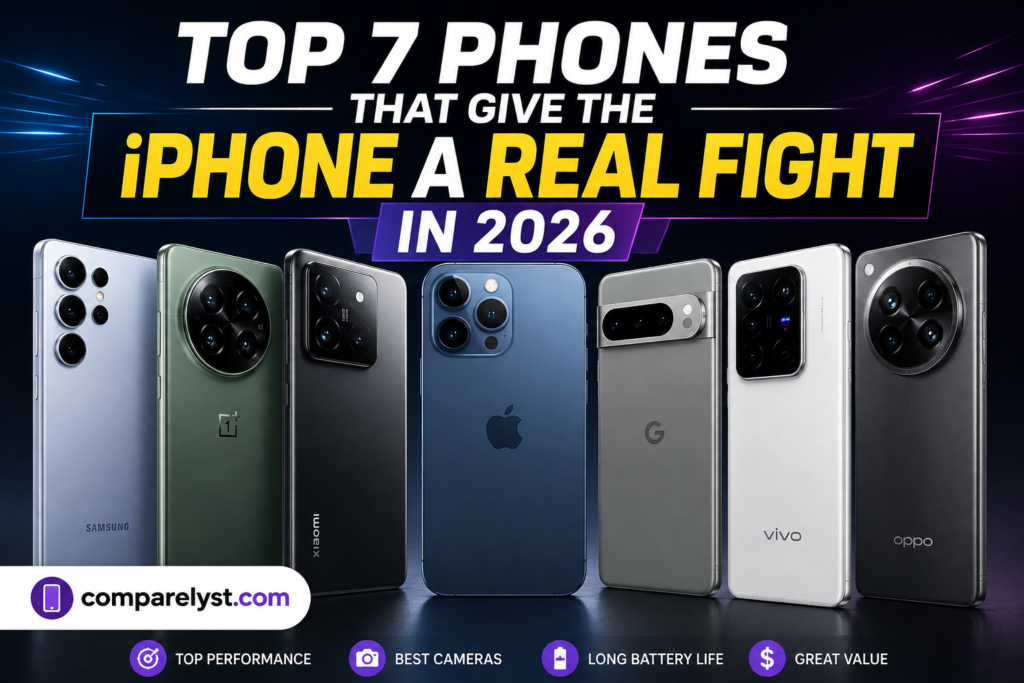
In this article, we will look at 7 premium smartphones that can give the iPhone a real competition. All of them have different strengths. Some phones focus on the camera. Some are ahead in performance. Some offer advantages in battery and charging. Some others are unique in AI and software experience.
Importantly, no phone on this list can be said to be better than the iPhone for all users. The winner will depend on your usage and preference.
1. Samsung Galaxy S26 Ultra – The biggest Android rival for the iPhone
When talking about flagship smartphones against the iPhone, the Samsung Galaxy S26 Ultra cannot be avoided.
Samsung’s Ultra series has been a very important competitor in the premium Android segment for many years. In 2026, the Galaxy S26 Ultra continues to strengthen that position.
The biggest advantage of the Galaxy S26 Ultra is its versatility.
A smartphone needs a large and premium display. The same phone needs an advanced camera system. High performance when gaming. Features like the S Pen when performing productivity tasks. AI tools and customization options.
For users who want to get all of this in one device, the S26 Ultra is a strong alternative.
The biggest advantage of the Android experience over the iPhone is customization.
From the home screen to widgets, users can customize many things to their liking. Samsung’s software ecosystem also places great emphasis on multitasking and productivity features.
Samsung flagship phones also emphasize versatility on the camera side.
One user may be enough for normal photography. Another may need zoom photography. Another may create video and social media content.
Multiple camera capabilities are useful for these types of users.
The S26 Ultra is a powerful choice for gaming due to its flagship hardware.
At the same time, the simplicity and ecosystem integration of the iPhone may appeal to some users even more.
So the Samsung Galaxy S26 Ultra vs iPhone is not just an “Android vs iOS” comparison.
It is a comparison of customization and versatility vs simplicity and ecosystem.
2. Google Pixel 10 Pro XL – iPhone Challenger in Camera and AI
The Google Pixel series initially created an image of a camera-centric smartphone. But now Pixel phones are being noticed in the premium segment not only because of the camera but also because of the AI and software experience.
The biggest attraction of a model like the Pixel 10 Pro XL is computational photography.
Camera hardware alone does not make a good photo.
Image processing is very important.
Google has a unique approach to the way it processes photos through its software and AI processing.
The Pixel experience may appeal to many photography enthusiasts in situations like portrait photography, everyday photos and difficult lighting conditions.
Another advantage of the Pixel is the clean Android experience.
The Pixel is very attractive to users who want to use Android close to its original design philosophy.
Brands like Samsung offer more customization and additional features.
Pixel, on the other hand, focuses more on a comparatively clean interface and Google services integration.
AI features are also an important part of the Pixel experience.
AI integration is more visible in areas like photo editing, voice-related features, search, and productivity.
The iPhone’s biggest strength is its ecosystem, while the Pixel’s strength is its Google ecosystem.
The Pixel may be very convenient for those who use Google Photos, Gmail, Google Drive, Chrome, and other Google services on a daily basis.
If camera and AI are important, the Pixel 10 Pro XL is a real competitor to the iPhone.
3. OnePlus 15 – A different approach to speed and charging
OnePlus has been a brand that has built its identity as “fast” since its inception.
A flagship model like the OnePlus 15 in 2026 is an interesting alternative for performance-focused users.
The first thing that many users think of when buying a OnePlus phone is performance.
Apps should open fast.
Multitasking should be smooth.
Games should run at a good frame rate.
There should be no unnecessary lag while using the phone.
OnePlus places great importance on this experience.
Fast charging is also a major advantage of OnePlus.
If your iPhone battery is low, you may need to plan your charging time.
Fast-charging is a great way to get more battery in less time on your Android phone.
Travelers, gamers, or heavy phone users will really appreciate this feature.
The OnePlus software experience is also focused on speed and smoothness.
At the same time, the iPhone’s software ecosystem and long-term integration may be important to some users.
But for users who say, “I want a fast phone, I want fast charging, I want gaming performance,” the OnePlus 15 is a strong alternative.
4. Xiaomi 17 Ultra – Challenging iPhone in Camera Hardware
Xiaomi continues to focus on camera technology in the premium smartphone market.
Flagship models like the Xiaomi 17 Ultra are very interesting for photography enthusiasts.
The Xiaomi Ultra series is attractive to those who want to use a smartphone camera as a serious photography device, not just a casual photography tool.
Large camera hardware, advanced imaging technology, and different shooting capabilities are key parts of the Xiaomi flagship experience.
One interesting thing about photography is that not everyone likes the same image processing style.
Some users like natural-looking photos.
Some like high contrast and vibrant colors.
Some users like a DSLR-like look.
Camera-focused brands like Xiaomi are trying to offer more control and hardware capabilities in this segment.
The iPhone’s biggest camera advantage is consistency.
The point-and-shoot experience is generally simple.
Xiaomi’s advantage may be more flexibility for photography enthusiasts.
So for serious camera users, the Xiaomi 17 Ultra may be more than just a phone, but a photography tool.
5. Vivo X300 Pro – For Portrait and Photography Lovers
Vivo flagship phones focus more on photography and portrait experience.
One of the main reasons to consider a model like the Vivo X300 Pro as an alternative to the iPhone is the camera experience.
Subject separation, skin tones, and background rendering are important for users who love portrait photography.
Just having a high camera specification on a phone is not enough.
Real-world image processing is important.
Vivo develops the flagship camera experience with this in mind.
These types of phones are also useful for users who do travel photography.
In addition to taking landscape photos in one place, you will have to handle many situations such as people, food, night scenes, and moving subjects.
Camera processing is important in this type of mixed photography.
Vivo X300 Pro performance is also positioned to provide a flagship-level experience.
So it’s an interesting alternative for users looking for a premium Android phone that balances both camera and performance.
6. Oppo Find X9 Pro – Premium Design and Camera Experience
The Oppo Find series is trying to balance both design and camera experience in the premium smartphone market.
The first attraction of a phone like the Oppo Find X9 Pro is its premium design.
When buying a smartphone, specifications are not the only thing that matters.
How the phone feels in the hand is also important.
Build quality, weight distribution, display and overall design affect the daily usage experience.
Oppo flagship phones also place a lot of emphasis on the camera experience.
This is interesting for users who like photography and portrait shots.
Oppo flagship models also focus on the battery and charging experience.
This may be more convenient for those who use the phone heavily daily.
The design language of the iPhone is very recognizable.
But on the Android side, many brands have their own unique approach to premium design.
Oppo is a prime example of this.
If you think “I want a premium-looking Android phone; don’t want to compromise on camera and charging”, then the Find X9 Pro is a model that can be shortlisted.
7. Samsung Galaxy Z Fold Series – A Completely Different Challenge to iPhone
The Galaxy Z Fold series is a bit different on this list.
Because it tries to change the smartphone concept itself rather than directly competing with the iPhone as a traditional smartphone.
A normal iPhone screen is of a certain size.
But when you open the Galaxy Z Fold phone, you get a large inner display.
This opens up new possibilities for multitasking and productivity.
A foldable display is useful for using two applications at the same time, viewing documents, watching large-screen videos, and performing work-related tasks.
For a business user, it may be more practical than a traditional smartphone.
Similarly, users with high content consumption may also like a large inner screen.
But not everyone needs a foldable phone.
Those who want a phone that is simple, lightweight, and durable in a traditional form factor may prefer the iPhone or the Galaxy S series.
Buyers of foldable phones should first consider whether they are actually going to use its unique form factor.
From that perspective, the Galaxy Z Fold series is a completely different type of competition for the iPhone.
Is Camera alone enough to compete with the iPhone?
This is a very important question.
A phone’s camera may be better than the iPhone.
But that doesn’t mean that the phone is better overall.
Smartphone experience is a combination of many things.
- Camera.
- Battery.
- Performance.
- Display.
- Software.
- Security.
- Updates.
- Apps.
- Ecosystem.
- Accessories.
- Customer support.
All of these together create a smartphone experience.
For example, if someone uses a MacBook, integration with the iPhone is very useful for him.
Similarly, if someone uses a Windows PC and Google services a lot, an Android phone may be convenient for him.
Therefore, in smartphone comparison, you should not make a decision based on technical specifications alone.
Who is the iPhone’s competitor in gaming?
When it comes to gaming performance, flagship Android phones are very strong.
Brands like Samsung, OnePlus, and Xiaomi focus on powerful processors and high-refresh-rate displays.
The iPhone’s chipset performance has been one of its strongest points for years.
But Android phones can offer some additional advantages, such as cooling systems, large displays, and fast charging.
If you’re a heavy gamer, you should look beyond the processor and look at thermal performance.
A phone may be very fast to begin with.
But after 30 to 60 minutes of gaming, performance can change if the heat builds up.
That’s why real-world gaming experience is important.
Who leads in battery and charging?
In this category, Android flagship phones give the iPhone a strong challenge.
Fast charging technology, in particular, is growing very aggressively in the Android ecosystem.
Getting a full charge in a short time after a phone’s battery runs low is a practical advantage in daily life.
iPhone users can get a better experience through battery optimization and overall efficiency.
But if charging speed is important, brands like OnePlus, Xiaomi, Vivo, and Oppo are interesting alternatives.
Travelers may especially notice this difference.
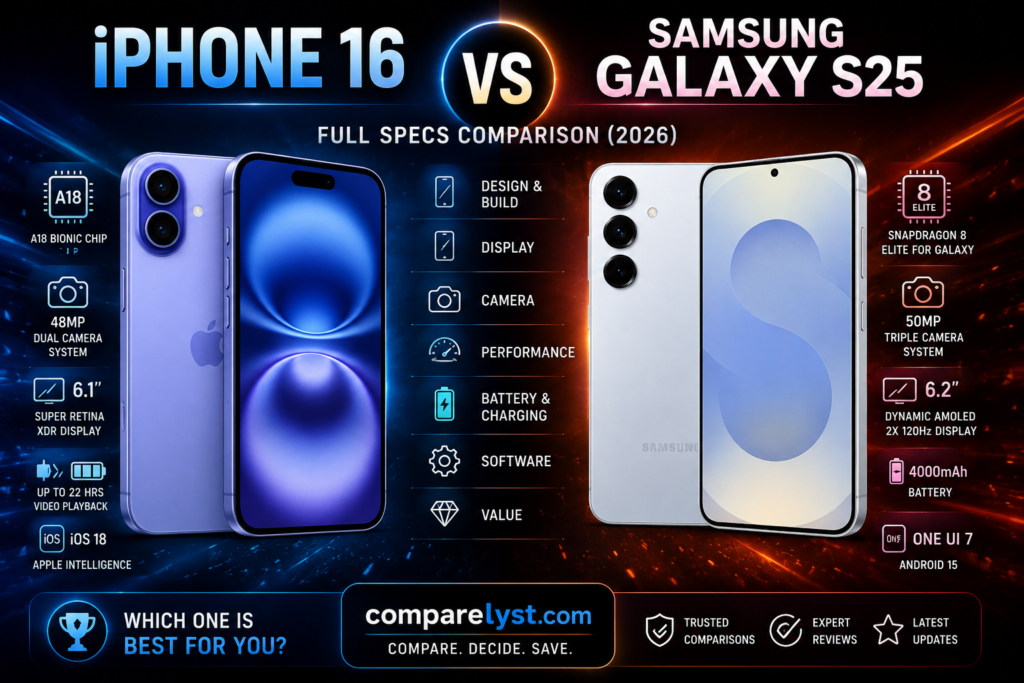
Samsung Still Strong on Display
Samsung is a big name when it comes to premium displays.
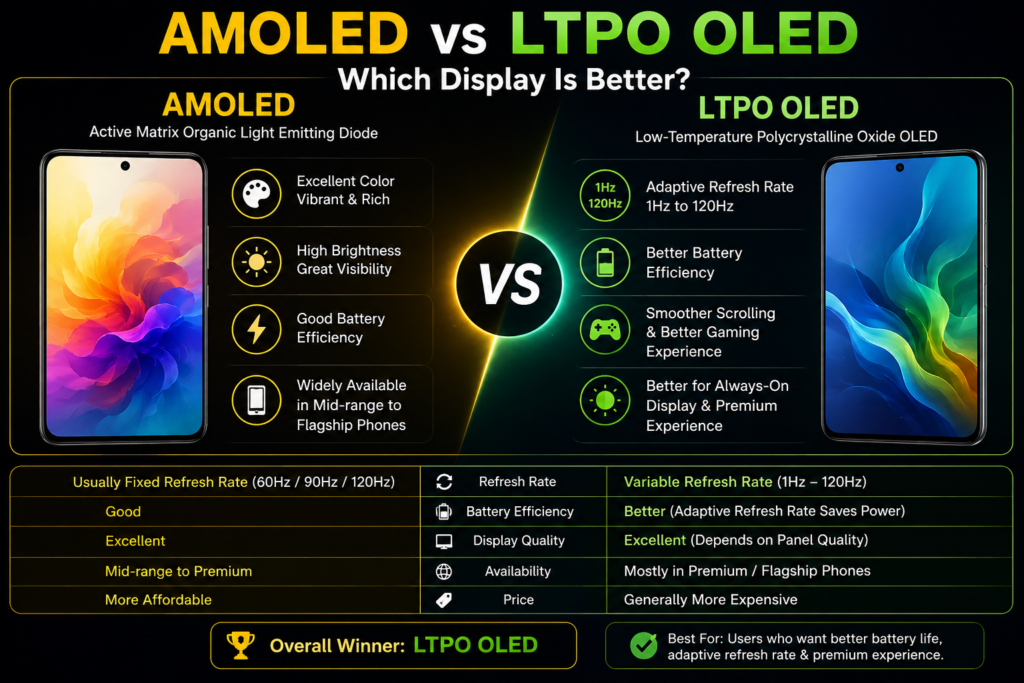
Galaxy flagship phones typically offer bright and high-quality AMOLED displays.
Display quality makes a big difference in movies, gaming, photos, and outdoor usage.
iPhone displays are also premium quality.
But on the Android side, Samsung’s combination of display technology and customization may appeal to some users.
Do you want a large screen?
Do you want a compact screen?
Do you want a high refresh rate?
Is outdoor brightness important?
These preferences could determine the winner.
Software Experience – iOS vs Android
One of the iPhone’s biggest strengths is iOS.
Simple interface.
Consistent experience.
Strong ecosystem.
Long-term updates.
Security.
This combination is very attractive to many users.
Android phones, on the other hand, offer customization and flexibility.
Samsung One UI, Pixel software, OnePlus interface, Xiaomi software, and Vivo/Oppo interfaces each offer a different experience.
So for an Android user, the simplicity of the iPhone can sometimes seem restrictive.
For an iPhone user, Android customization can seem like unnecessary complexity.
This is not a pure technical difference.
This is personal preference.
AI Features – Key Competitors in 2026
AI is a major battleground in the 2026 smartphone market.
Samsung Galaxy focuses on areas like productivity and photo editing with AI features.
Google Pixel focuses more on AI and Google ecosystem integration.
Apple continues to grow its AI ecosystem.
Other Android brands also offer AI-based photography, writing assistance, translation and productivity features.
But just because a phone has more AI features doesn’t mean it’s automatically better.
The AI features that you use every day are what matter.
For example, AI object removal is very useful for those who do a lot of photo editing.
Translation features are useful for those who travel.
Writing or summarization tools are useful for those who work.
So, practical usefulness is more important than AI marketing numbers.
Who is the real competitor to the iPhone?
If you have to choose only one phone, the answer depends on the user.
If you want an overall premium Android experience, the Samsung Galaxy S26 Ultra is a strong contender.
If camera and AI are important, the Google Pixel 10 Pro XL is a serious competitor.
If performance and fast charging are important, the OnePlus 15 is attractive.
If advanced photography is important, the Xiaomi 17 Ultra is a phone to consider.
If portrait photography and a camera experience are important, the Vivo X300 Pro is interesting.
If you want a premium design, camera, and charging balance, the Oppo Find X9 Pro is a good alternative.
If you want a large-screen productivity and foldable experience, the Galaxy Z Fold series is a completely different option.
Should you buy an Android flagship without buying an iPhone?
The answer to this is not a simple “yes” or “no”.
Look at your current ecosystem first.
If you use a MacBook, iPad, and Apple Watch, switching from iPhone to Android may require some adjustments.
But if you are already comfortable with Windows PC, Google services, and the Android ecosystem, an Android flagship phone is a very natural choice.
Similarly, if specific features like camera and charging speed are important to you, an Android alternative may be a better fit.
An Important Rule When Buying a Smartphone in 2026
Don’t buy a phone just because “this phone is the latest”.
Write down your needs first.
Is the camera important?
Is gaming important?
Is the battery important?
Do you want fast charging?
Do you want a large display?
Do you want a compact phone?
Do you want AI features?
Do you want long software support?
Is the ecosystem important?
After answering these questions, it’s very easy to find out which phone is right for you.
Final Verdict – 7 Phones That Can Compete with the iPhone
In 2026, the iPhone is still a major player in the premium smartphone market.
But there are many strong phones in the Android ecosystem to compete with it.
The Samsung Galaxy S26 Ultra competes with versatility and a premium Android experience.
The Google Pixel 10 Pro XL offers a unique experience with its camera and AI.
The OnePlus 15 targets performance-focused users with its performance and charging speed.
Xiaomi 17 Ultra is a powerful alternative for photography enthusiasts.
Vivo X300 Pro focuses on camera and portrait experience.
Oppo Find X9 Pro offers premium design and balanced flagship experience.
Galaxy Z Fold series goes beyond the traditional smartphone concept and offers a different experience with a large foldable screen.
It is not possible to say which phone completely “defeats” the iPhone.
Instead, each phone challenges a specific strength of the iPhone.
iPhone may be the strongest in the ecosystem.
Samsung is strong in versatility.
Pixel is strong in photography and AI.
OnePlus is strong in speed and charging.
Xiaomi is strong in camera hardware.
Vivo is strong in portrait photography.
Oppo is strong in design and charging experience.
Foldable phones offer a completely different experience in productivity.
So, when buying a smartphone in 2026, don’t just look at “iPhone vs Android”.
Instead, ask:
“Which phone is best for my usage?”
The answer to that one question will help you choose the right smartphone.
Comparelyst.com – Compare. Decide. Buy Smart.
Frequently Asked Questions
- Which is the best Android competitor to the iPhone in 2026?
The Samsung Galaxy S26 Ultra is a strong competitor in terms of overall premium experience. But alternatives like Pixel for camera and OnePlus for performance are also strong.
2. Which phone can compete with iPhone for camera?
Flagship phones like Google Pixel 10 Pro XL, Samsung Galaxy S26 Ultra, Xiaomi 17 Ultra and Vivo X300 Pro are strong alternatives for camera-focused users.
3. Which phone can you buy as an alternative to iPhone for gaming?
Performance-focused Android flagship phones, especially high-end models from brands like OnePlus, Samsung and Xiaomi, are interesting choices for gaming.
4. Which phone is best if fast charging is important?
Android brands like OnePlus, Xiaomi, Vivo and Oppo generally place more emphasis on fast-charging technology.
5. Which is better Samsung S26 Ultra or iPhone?
If customization, S Pen, Android flexibility and a versatile camera system are important to you, Samsung is attractive. If ecosystem integration, iOS simplicity, and Apple services are important to you, the iPhone is a better fit.
6. Why are Pixel phones popular?
Google Pixel phones are popular because of their camera processing, clean Android experience, and AI features.
7. Are foldable phones a better alternative to the iPhone?
Not for everyone. But if multitasking and large-screen productivity are important, foldable phones like the Galaxy Z Fold could offer a completely different experience than a traditional iPhone.
8. Is it worth buying an Android phone over an iPhone in 2026?
Yes, especially if your priority is fast charging, customization, large display, camera versatility, or a foldable design, an Android flagship could be an excellent alternative.
9. Should you only look at specifications when buying a phone?
No. You should also consider camera, battery, software support, display, performance, ecosystem, warranty, and your actual daily usage.
At Comparelyst.com, you can easily find the information you need to buy your next smartphone through smartphone comparisons, camera guides, display comparisons, performance articles, and mobile technology information.
Disclosure: As an Amazon Associate, Comparelyst earns from qualifying purchases.