Xiaomi 17 Ultra vs Samsung Galaxy S26 Ultra – The Camera Ultra War
When it comes to buying a flagship smartphone in 2026, camera quality has become an important deciding factor. How powerful a smartphone’s processor is is not enough. Today, users capture everything from travel photos, portraits, night shots, wildlife photos, videos and social media content through their phone cameras.
So, the camera has become a separate competition in the premium smartphone market.
The two Ultra phones that will be most interesting in this competition in 2026 are the Xiaomi 17 Ultra and the Samsung Galaxy S26 Ultra.
Both phones are not ordinary flagship smartphones. Both have powerful processors, premium displays, advanced camera systems, AI features and high-end hardware.
But the camera philosophy of these two phones is not the same.
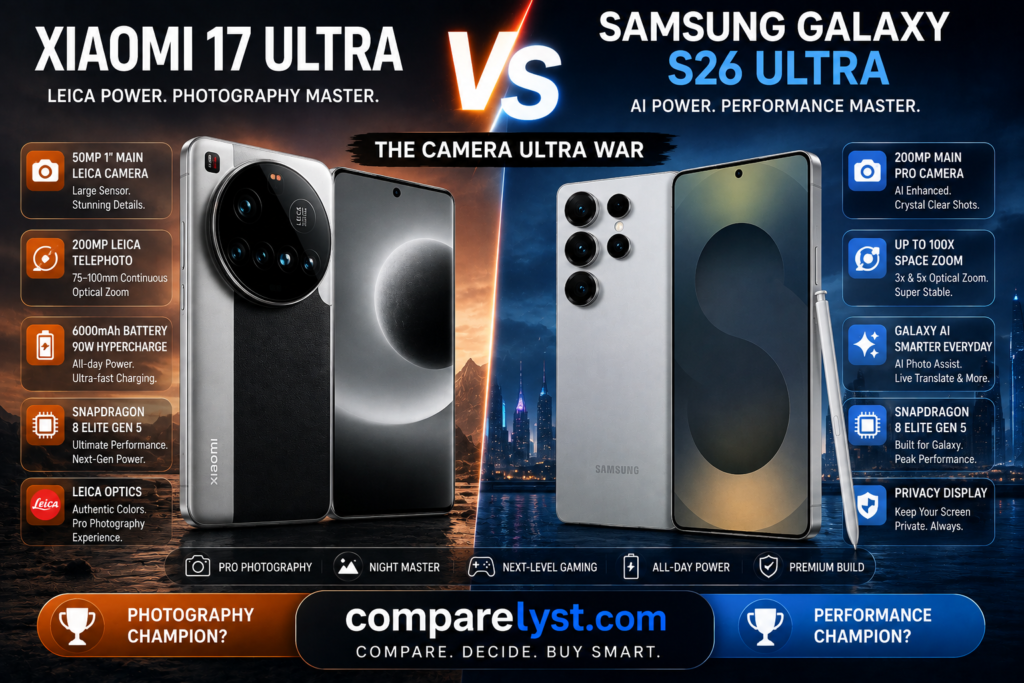
The Xiaomi 17 Ultra highlights the Leica partnership, a large 1-inch-class main sensor and a 200MP continuous optical zoom system in the camera experience. The Xiaomi 17 Ultra has a 50MP Leica main camera, 200MP Leica telephoto and 50MP ultra-wide camera.
The Samsung Galaxy S26 Ultra, on the other hand, offers a 200MP main camera, 50MP ultra-wide, 50MP 5x telephoto and 10MP 3x telephoto system. Samsung focuses on ProVisual Engine, wider apertures and improved low-light photography with this.
So this comparison cannot be seen as just a megapixel comparison.
It is really a “Leica camera philosophy vs Samsung computational photography” contest.
Xiaomi 17 Ultra vs Galaxy S26 Ultra – What is the difference at first glance?
First, let’s understand the approach of these two phones in a simple way.
The Xiaomi 17 Ultra is designed as a camera-first flagship.
Leica optics, large sensor, 200MP telephoto and variable focal-length photography target photography enthusiasts.
The Samsung Galaxy S26 Ultra is an all-round Ultra flagship.
Samsung is trying to combine not just the camera but also the display, S Pen, AI, privacy features, performance, productivity and ecosystem in a single device.
So a photography enthusiast might prefer the Xiaomi 17 Ultra.
A business user or productivity-focused user might prefer the Galaxy S26 Ultra.
But when it comes to the camera war, the competition is very close.
Design – Both Ultra phones are premium
The Xiaomi 17 Ultra has a simple and refined flagship look in its design.
Its large camera module is what immediately catches the eye on the rear side.
It doesn’t look like a normal smartphone camera, but rather feels like a dedicated camera system.
Xiaomi states that the thickness of the Xiaomi 17 Ultra is about 8.29mm and the weight is about 218.4g.
The Samsung Galaxy S26 Ultra offers an even slimmer design.
Its thickness is 7.9mm and weight is 214g.
The design of the Galaxy S26 Ultra is relatively minimal.
The camera modules are separate, but the overall body is clean.
Samsung has given more importance to slimness and lightweight design in this generation.
Both give a premium feel when held in the hand.
But the Xiaomi 17 Ultra may appeal more to users who like a camera-centric appearance.
The Galaxy S26 Ultra is attractive to users who like a minimal flagship design.
Display – Xiaomi vs Samsung
Even in a camera comparison, the display cannot be ignored.
The phone display itself shows how the photo or video we take looks.
The Xiaomi 17 Ultra has a 6.9-inch HyperRGB OLED display.
It has a resolution of 2608 × 1200 and adaptive 1Hz to 120Hz refresh rate support.
Xiaomi states that the peak brightness will go up to 3500 nits.
There is also HDR10+ and Dolby Vision support.
The Samsung Galaxy S26 Ultra has a 6.9-inch Dynamic AMOLED 2X display.
It has a 120Hz adaptive refresh rate and 2600 nits peak brightness.
Both displays are in the premium category.
Both are excellent for movies, gaming, photography editing and outdoor usage.
The Xiaomi display is impressive in specifications due to features like higher peak brightness and Dolby Vision.
Samsung display strength is in color processing and technologies like ProScaler.
So it’s hard to say a single phone is the display winner.
High brightness and media features – Xiaomi 17 Ultra
Overall refined flagship display experience – Galaxy S26 Ultra
Main Camera – The most important part of this competition
Now let’s get to the real camera war.
The main camera of Xiaomi 17 Ultra has a 50MP resolution.
But the megapixel count is not the only important feature.
It has a 1-inch-class Light Fusion 1050L sensor and a Leica Summilux optical system.
The larger sensor helps capture more light.
This has the potential to improve image quality in low-light photography, portraits, and dynamic scenes.
Xiaomi also uses LOFIC HDR technology in this camera.
The aim is to better handle bright highlights and dark shadows in the same image.
The Samsung Galaxy S26 Ultra has a 200MP main camera.
Its aperture is f/1.4.
Samsung is trying to improve low-light photography and overall image quality with a wider aperture and improved ProVisual Engine.
Here, the two phones use different strategies.
Xiaomi:
Large sensor + Leica optics + hardware-focused imaging
Samsung:
High-resolution sensor + wider aperture + computational photography
Both phones can deliver extremely detailed images in daylight.
But the Xiaomi 17 Ultra is interesting for those who want natural depth, optical character and camera-like image rendering.
Samsung is attractive for those who want AI processing, HDR and social-media-ready images.
Leica vs Samsung ProVisual Engine
This is the most interesting part of this comparison.
The Xiaomi 17 Ultra has a Leica partnership.
Leica influence is visible in the camera colours, image styles and optical rendering.
Xiaomi offers photographic styles such as Leica Authentic Look and Leica Vibrant Look.
Authentic Look targets a natural and classic photography feel.
Vibrant Look will emphasize colors more.
This allows photography enthusiasts to choose their favorite image style.
The ProVisual Engine plays a key role in the Samsung Galaxy S26 Ultra.
Samsung optimizes colors, details, noise, and dynamic range through AI and image processing.
This makes Samsung very convenient for point-and-shoot photography.
Those who want to take a photo and upload it to social media without editing it may like Samsung processing.
Those who view photography as a creative hobby may like Xiaomi’s Leica approach.
Telephoto Camera – Xiaomi 17 Ultra’s Biggest Weapon
The Xiaomi 17 Ultra’s biggest advantage in the Camera Ultra War is its telephoto system.
It has a 200MP Leica telephoto camera.
It offers a variable focal range from 75mm to 100mm.
Xiaomi promotes this as a continuous optical zoom system.
This provides optical flexibility in focal lengths from 75mm to 100mm.
What is its practical benefit?
You can use a 75mm perspective when taking a portrait.
You can go up to 100mm when capturing a distant subject.
Having multiple focal lengths in a single telephoto camera is very useful for photography enthusiasts.
The telephoto camera also supports 30cm macro photography.
This makes the Xiaomi 17 Ultra a versatile camera system.
Samsung Galaxy S26 Ultra Telephoto
Telephoto photography is also very serious on the Samsung Galaxy S26 Ultra.
It has 50MP 5x telephoto and 10MP 3x telephoto cameras.
3x and 5x optical zoom are available.
2x and 10x optical-quality zoom options are also available with Adaptive Pixel technology.
Digital zoom goes up to 100x.
So Samsung uses a different strategy.
Xiaomi focuses on continuous optical zoom.
Samsung covers different zoom ranges with multiple dedicated telephoto cameras.
This is very useful for travel photography.
You can capture a building at 3x.
You can capture a distant subject at 5x.
If you need more zoom, you can use Samsung’s computational zoom.
Portrait Photography – Who takes natural photos?
Megapixels are not the only thing that matters in portrait photography.
Lens focal length, sensor size, depth, skin tones and background separation are also important.
The Xiaomi 17 Ultra’s large main sensor and Leica optics can help create a natural depth-of-field effect.
Portraits taken with a telephoto camera can give the subject a natural perspective.
Portraits can give a camera-like appearance due to Leica image processing.
The Samsung Galaxy S26 Ultra uses AI processing more in portrait photography.
Skin tones, edge detection, and background separation are optimized through software.
Samsung portraits are attractive to social media users.
Xiaomi portraits can give a more natural feel to photography enthusiasts.
Preference is important in this category.
Night Photography – The real camera war at night
Night photography is the real test of a flagship camera.
In daylight, almost all premium phones take good photos.
But at night, the difference in sensor quality and image processing is clearly visible.
The Xiaomi 17 Ultra’s 1-inch-class main sensor is a big advantage for low-light photography.
The larger sensor captures more light.
It tries to control highlights and shadows better due to the combination of Leica optics and LOFIC HDR.
This makes Xiaomi strong in scenes like night street photography, indoor portraits, and city lights.
The Samsung Galaxy S26 Ultra has a wider f/1.4 main aperture and improved Nightography features.
Samsung has especially improved low-light photography and Nightography Video.
This makes Samsung also very strong in night photography.
Xiaomi is very interesting when looking at the pure hardware approach.
Samsung is strong when looking at AI-assisted night processing and easy point-and-shoot experience.
Ultra-Wide Camera
The Xiaomi 17 Ultra has a 50MP ultra-wide camera.
Its focal length is 14mm equivalent and offers a 115-degree field of view.
It is useful for landscape photography, architecture, group photos, and travel photography.
The Samsung Galaxy S26 Ultra has a 50MP ultra-wide camera.
Its aperture is f/1.9.
Both phones are flagship-level in the ultra-wide category.
It is difficult to call a phone a clear winner.
Travel photographers may like Xiaomi’s Leica processing.
Everyday users may like Samsung’s consistency.
Macro Photography
The Xiaomi 17 Ultra is also interesting in macro photography.
Its 200MP telephoto camera supports 30cm macro photography.
This allows you to capture flowers, insects, small objects, and product details.
The Samsung Galaxy S26 Ultra’s multiple camera system is capable of close-up photography.
But Xiaomi’s telephoto macro approach is a unique advantage for photography enthusiasts.
Macro photography – Xiaomi 17 Ultra
Video Recording
Camera comparison is not just about photos.
Both phones are flagship-level in video recording.
The Xiaomi 17 Ultra supports 8K video recording at 30fps.
It also supports 4K Dolby Vision recording at 30fps, 60fps and 120fps.
There is also log video recording up to 4K 120fps and ACES support.
This is very powerful for mobile filmmaking.
The Samsung Galaxy S26 Ultra supports 8K video recording and 4K 120fps Pro Video.
Samsung has focused on improving low-light video quality with Nightography Video.
Both are excellent for video creators.
But the Xiaomi is more interesting due to features like professional color workflow and high-frame-rate Dolby Vision.
Samsung’s advantage is easy-to-use Pro Video tools and AI processing.
Selfie Camera
The Xiaomi 17 Ultra has a 50MP autofocus front camera.
Its field of view is about 90 degrees and supports 4K Dolby Vision video recording.
The Samsung Galaxy S26 Ultra has a 12MP autofocus selfie camera.
Samsung is also trying to improve highlights and shadows in selfies by using an AI image signal processor in the front camera.
Xiaomi is ahead in terms of megapixel count alone.
But actual selfie quality depends on software processing.
Xiaomi’s wider field of view is useful for group selfies and video calls.
Samsung’s AI processing helps provide natural-looking selfies.
Performance – Speed is important even though it is a camera phone
These two phones are not just camera phones.
Both have a Snapdragon 8 Elite Gen 5 processor.
The Xiaomi 17 Ultra uses the Snapdragon 8 Elite Gen 5 3nm platform.
The Samsung Galaxy S26 Ultra has a customized Snapdragon 8 Elite Gen 5 processor for Galaxy.
Samsung mentions that it has improved the CPU, GPU, and NPU performance.
As a result, both phones are powerful in gaming, video editing, AI processing, and multitasking.
Samsung’s customized tuning of the processor gives an advantage to thermal management and AI workloads.
Xiaomi uses a 3D Dual-Channel IceLoop cooling system.
The purpose of this is to improve heat management during prolonged gaming and video recording.
So both are flagship level in performance.
Gaming – Xiaomi 17 Ultra vs Galaxy S26 Ultra
Although gaming is not the main topic of the camera comparison, it is important when buying a flagship phone.
The Xiaomi 17 Ultra is designed to handle demanding games thanks to the Snapdragon 8 Elite Gen 5 and advanced cooling system.
The Samsung Galaxy S26 Ultra also has a customized Snapdragon processor and improved vapor chamber cooling.
Samsung focuses on sustained performance for long gaming sessions and multitasking.
Both offer a high-end gaming experience.
But if someone buying a camera-centric phone makes gaming a secondary priority, both phones will suffice.
Battery – Who will last longer?
The Xiaomi 17 Ultra has a 6000mAh battery.
It also has 90W wired HyperCharge and 50W wireless HyperCharge support.
This is a huge advantage for heavy users.
The large battery is useful for long photography sessions, 4K video recording, navigation, and gaming.
The Samsung Galaxy S26 Ultra has a 5000mAh typical battery.
Samsung claims up to 31 hours of video playback.
60W wired charging can charge up to 75% in about 30 minutes.
Xiaomi clearly ahead in raw battery capacity.
Xiaomi has the advantage in charging speed as well, with Xiaomi 90W vs Samsung 60W.
Battery winner: Xiaomi 17 Ultra
Display Brightness – Is it important for outdoor photography?
Display visibility in bright sunlight is important when taking photos.
Xiaomi 17 Ultra offers 3500 nits multi-scenario peak brightness.
Samsung Galaxy S26 Ultra offers 2600 nits peak brightness.
Thus, Xiaomi is brighter in specifications.
Bright display useful for outdoor photography, camera preview and video playback.
But actual outdoor visibility is not just about the brightness number; it also depends on screen coating, automatic brightness and viewing conditions.
AI Features – Samsung’s strong area
AI features are an inevitable part of a flagship phone in 2026.
Samsung Galaxy S26 Ultra has given a lot of emphasis to Galaxy AI and agentic AI experience.
According to Samsung, agentic AI features have been developed so that the phone can handle some routine tasks based on context.
AI also plays an important role in the camera.
ProVisual Engine improves image quality.
Xiaomi 17 Ultra also has Xiaomi HyperAI.
Features like AI Writing, AI Speech Recognition, AI Interpreter, AI Search and AI Creativity Assistant are available.
Features like Google Gemini and Circle to Search are also supported.
Both phones are strong in AI.
Samsung AI ecosystem can give a more mature and deeply integrated feel.
Xiaomi HyperAI is useful for tasks like daily productivity and translation.
Privacy and Security
One unique feature of Samsung Galaxy S26 Ultra is the built-in Privacy Display.
It is designed to protect the phone screen from prying eyes in public places.
This is useful when viewing sensitive information in places like crowded trains, airports, offices or public cafes.
The Xiaomi 17 Ultra offers an ultrasonic in-screen fingerprint sensor and AI face unlock.
Security is strong on both phones.
But Samsung has a unique practical advantage due to the privacy display.
Storage and RAM
The Xiaomi 17 Ultra offers high-end memory and storage configurations.
The India specifications use LPDDR5X RAM and UFS 4.1 storage.
The Samsung Galaxy S26 Ultra is available in 256GB, 512GB and 1TB storage options; memory configuration may vary depending on the market.
The 512GB or 1TB version is very practical for users who capture a lot of 4K and 8K videos.
Professional photography and video users should not skimp on storage.
Which phone is for photography enthusiasts?
If you take photography as a serious hobby, the Xiaomi 17 Ultra is very attractive.
Leica optics.
1-inch-class main sensor.
200MP telephoto.
Variable 75-100mm optical focal range.
Leica photographic styles.
RAW support.
Pro mode.
8K video.
4K 120fps Dolby Vision.
This combination gives a dedicated camera feel.
The Samsung Galaxy S26 Ultra also offers professional-level camera flexibility.
200MP main camera.
50MP ultra-wide.
50MP 5x telephoto.
10MP 3x telephoto.
100x digital zoom.
ProVisual Engine.
Nightography.
8K video.
This makes Samsung equally powerful for photography enthusiasts.
But if you look at camera hardware and optical flexibility alone, Xiaomi is more interesting.
Which phone is for Social Media Users?
Those who take photos and videos for platforms like Instagram, Facebook, and YouTube Shorts will value camera processing and convenience more.
Samsung’s point-and-shoot experience is very easy.
You get a color-rich output right after taking a photo.
You can quickly modify the image with AI editing tools.
Xiaomi’s Leica styles can give content a different visual character.
Using Authentic Look can make photos more natural and camera-like feel.
Vibrant Look is attractive for social media content.
The winner in this category is style preference.
Which phone is for Travel Photography?
Versatility is important in travel photography.
You want to capture a landscape in one location.
You want to capture a portrait at the same time.
You want to capture a distant building or mountain.
You want to capture close-up details.
The Xiaomi 17 Ultra’s camera system is very useful for all of these.
The 200MP telephoto and 75-100mm continuous optical zoom are a big advantage.
The Samsung Galaxy S26 Ultra also has 3x and 5x optical zoom options, making it very versatile for travel photography.
Even 100x digital zoom is useful in some situations.
But if you want natural optical zoom and camera-like rendering, Xiaomi has the advantage.
Which phone is for video creators?
If you are a video creator, you can consider both.
The Xiaomi 17 Ultra has capabilities like 4K 120fps Dolby Vision and Log video recording up to 4K 120fps.
This is attractive for advanced video workflows.
The Samsung Galaxy S26 Ultra has 8K video and 4K 120fps Pro Video support.
Samsung Nightography Video is useful for low-light content creators.
If you are more of a professional video workflow, Xiaomi.
Samsung means a lot when it comes to easy mobile content creation and AI-assisted editing.
Which phone is for normal users?
Here is an important point.
Both these phones are more than powerful for normal users.
Those who only do WhatsApp, Instagram, YouTube, calls, browsing and casual photography may not need an Ultra-level camera system.
But if you are buying a premium phone, these devices are useful due to future-proofing and camera quality.
Samsung UI and AI features are convenient for normal users.
Xiaomi has a large battery and fast charging is useful in daily life.
Important strengths of Xiaomi 17 Ultra
Xiaomi 17 Ultra’s biggest strength is the camera system.
1-inch-class main sensor.
Leica optics.
200MP telephoto.
75-100mm continuous optical zoom.
50MP ultra-wide.
50MP selfie camera.
8K video.
4K 120fps Dolby Vision.
6000mAh battery.
90W charging.
This combination is a very aggressive flagship specification.
It is very tempting for camera enthusiasts.
Some limitations of Xiaomi 17 Ultra
No phone is perfect.
Xiaomi 17 Ultra is relatively heavy due to its large camera hardware.
The camera module is large, so there is a noticeable camera bump when placing the phone on a flat surface.
Leica-style image processing is not for everyone.
Some users may prefer Samsung’s more processed and ready-to-share images.
Also, the Xiaomi HyperOS experience is different from Samsung One UI.
For those who use the Samsung ecosystem, switching to Xiaomi may require some adjustment.
Key strengths of Galaxy S26 Ultra
The Samsung Galaxy S26 Ultra is a complete flagship.
200MP main camera.
50MP ultra-wide.
50MP 5x telephoto.
10MP 3x telephoto.
100x digital zoom.
Dynamic AMOLED 2X display.
Snapdragon 8 Elite Gen 5 for Galaxy.
5000mAh battery.
60W charging.
S Pen support.
Galaxy AI.
Privacy Display.
This combination makes Samsung not just a camera phone but also a productivity flagship.
Some limitations of Galaxy S26 Ultra
The battery capacity of Galaxy S26 Ultra is 5000mAh.
If you compare it with Xiaomi 17 Ultra’s 6000mAh battery, Xiaomi has the advantage.
Xiaomi has 90W and Samsung 60W in charging speed.
Also, while Samsung’s camera hardware is impressive, Xiaomi’s 1-inch-class sensor and Leica optical system may give more camera-centric appeal to photography enthusiasts.
Samsung’s biggest strength is not just the camera.
It’s the overall flagship experience.
Camera War – Who wins in the end?
Now let’s come to the most important question of this entire comparison.
Xiaomi 17 Ultra vs Samsung Galaxy S26 Ultra – who is the camera winner?
If you have to give a single answer, it depends on your photography style.
If you value hardware and optical flexibility more, then Xiaomi 17 Ultra.
If you want Leica look and large sensor photography, then Xiaomi.
If you want more telephoto photography, then Xiaomi.
If you like macro photography, go for Xiaomi.
If you like long-range zoom photography, go for Samsung.
If you like AI image processing, go for Samsung.
If you want an easy point-and-shoot experience in night photography, go for Samsung.
If video and overall flagship features are important, Samsung is very strong.
Xiaomi 17 Ultra vs Galaxy S26 Ultra – Which phone is for whom?
If you are a photography enthusiast, go for Xiaomi 17 Ultra.
If you like Leica photography style, go for Xiaomi 17 Ultra.
If you want a large sensor camera experience, go for Xiaomi 17 Ultra.
If you want fast charging and a huge battery, go for Xiaomi 17 Ultra.
If you do a lot of zoom photography, both phones are good; Xiaomi is more interesting due to its optical flexibility.
If you use AI features a lot, go for Galaxy S26 Ultra.
If you are going to use the S Pen, go for Galaxy S26 Ultra.
If you are in the Samsung ecosystem, go for Galaxy S26 Ultra.
If you want practical features like privacy display, go for Galaxy S26 Ultra.
If you want an all-round flagship, go for Galaxy S26 Ultra.
Should you buy a camera phone in 2026?
Camera quality is improving rapidly in the 2026 smartphone market.
A few years ago, there was a huge difference between smartphone cameras and dedicated cameras.
Now that gap is narrowing.
Phones like the Xiaomi 17 Ultra use more optical hardware.
Phones like the Samsung Galaxy S26 Ultra combine hardware + AI + computational photography.
So a smartphone camera is not just a megapixel number.
Sensor.
Lens.
Aperture.
OIS.
Image processing.
AI.
Zoom.
Video capabilities.
All of these together create a camera system.
This is what you should look for when buying a phone.
Comparelyst.com Final Verdict
Both Xiaomi 17 Ultra and Samsung Galaxy S26 Ultra are the most powerful smartphones in the premium Ultra category of 2026.
But the identities of the two are different.
Xiaomi 17 Ultra = Camera-first Ultra
Galaxy S26 Ultra = All-round Ultra
The biggest advantage of Xiaomi 17 Ultra is its Leica camera system.
The 1-inch-class 50MP main sensor, 200MP telephoto, 75-100mm continuous optical zoom and 50MP ultra-wide are very impressive for photography enthusiasts.
Also, the 6000mAh battery and 90W charging make Xiaomi strong for heavy users.
The Samsung Galaxy S26 Ultra, on the other hand, is a complete flagship.
200MP main camera, dual telephoto setup, 50MP ultra-wide, 100x digital zoom, Galaxy AI, S Pen, Privacy Display and Snapdragon 8 Elite Gen 5 for Galaxy are available in a single device.
So if you look at the camera alone, the Xiaomi 17 Ultra is very exciting.
If you look at Camera + AI + productivity + S Pen + ecosystem, the Galaxy S26 Ultra is a very complete package.
Photography enthusiast – Xiaomi 17 Ultra
Leica camera experience – Xiaomi 17 Ultra
Telephoto flexibility – Xiaomi 17 Ultra
Battery – Xiaomi 17 Ultra
Fast charging – Xiaomi 17 Ultra
AI features – Galaxy S26 Ultra
S Pen & productivity – Galaxy S26 Ultra
Privacy features – Galaxy S26 Ultra
Overall all-round flagship – Galaxy S26 Ultra
But in the end, if you look at the “Camera Ultra War”, the Xiaomi 17 Ultra is not only a serious challenger in this competition; The Samsung Galaxy S26 Ultra gives a tough competition to the camera hardware and optical flexibility.
If you think the camera is the most important feature in a smartphone, you can definitely consider the Xiaomi 17 Ultra.
If you want a complete flagship experience with a camera, the Galaxy S26 Ultra is a very balanced choice.
So, for those looking for the best camera Ultra in 2026, the Xiaomi 17 Ultra is a strong recommendation.
For those looking for the best all-round Ultra, the Galaxy S26 Ultra is a safer choice.
Both phones are powerful.
Both phones are premium.
Both phones have excellent cameras.
But your photography style will determine the final decision.
Do you want Leica’s camera character? Xiaomi 17 Ultra.
Do you want Samsung’s AI-powered flagship experience? Galaxy S26 Ultra.
That’s the real answer to this Camera Ultra War.
Frequently Asked Questions
- Xiaomi 17 Ultra vs Galaxy S26 Ultra – Which is better for camera?
When it comes to camera hardware and optical flexibility, the Xiaomi 17 Ultra is very strong. Leica optics, 1-inch-class main sensor and 200MP telephoto are its biggest advantages. The Galaxy S26 Ultra is also very capable with its 200MP main camera, dual telephoto and advanced computational photography.
2. Does the Xiaomi 17 Ultra have a Leica camera?
Yes. The Xiaomi 17 Ultra has a Leica VARIO-APO-SUMMILUX camera system. Leica photographic styles and Leica optical technologies are used.
3. How many cameras does the Galaxy S26 Ultra have?
The Galaxy S26 Ultra has a 200MP main camera, 50MP ultra-wide, 10MP 3x telephoto and 50MP 5x telephoto cameras.
4. How much is the Xiaomi 17 Ultra battery?
Xiaomi 17 Ultra has a 6000mAh typical battery. It supports 90W wired HyperCharge and 50W wireless HyperCharge.
5. How much is the Galaxy S26 Ultra battery?
The Galaxy S26 Ultra has a 5000mAh typical battery. Samsung says that it can charge up to 75% in about 30 minutes with 60W wired charging.
6. Which phone is better for gaming?
Both have the Snapdragon 8 Elite Gen 5 platform, which gives flagship-level gaming performance. Xiaomi offers advanced cooling and a large battery; Samsung focuses on sustained performance with customized processor and vapor chamber cooling.
7. Which is better for night photography?
Both phones are strong in night photography. Xiaomi’s large main sensor gives it a hardware advantage. Samsung focuses on low-light photography with a wider aperture and ProVisual Engine/Nightography processing.
8. Which phone should you buy for zoom photography?
The Xiaomi 17 Ultra’s 200MP telephoto and 75-100mm continuous optical zoom are very interesting. Samsung has 3x and 5x optical telephoto cameras and up to 100x digital zoom. You can choose one of the two depending on your shooting style.
9. Should you buy the Xiaomi 17 Ultra in 2026?
If photography, zoom, battery and fast charging are your top priorities, the Xiaomi 17 Ultra is a strong flagship choice.
10. Who is the Galaxy S26 Ultra better for?
If you want AI, S Pen, productivity, privacy features, Samsung ecosystem and an all-round flagship experience with a camera, the Galaxy S26 Ultra is the most suitable.
11. Xiaomi 17 Ultra vs Galaxy S26 Ultra – Which should you finally buy?
If you are a camera-first user, then the Xiaomi 17 Ultra.
12. If you are an all-round flagship user, then the Galaxy S26 Ultra.
The best decision is to choose a phone that suits your daily usage and priorities.
At Comparelyst.com, you can easily find the information you need to buy your next smartphone through smartphone comparisons, camera guides, display comparisons, performance articles, and mobile technology information.
Stack both Ultras against each other on Comparelyst — free, no signup, 490+ phones.
Disclosure: As an Amazon Associate, Comparelyst earns from qualifying purchases.