iPhone Air vs Galaxy S25 Edge – Who is the Winner in Ultra-Thin Phone?
In the smartphone world, a big battery, a big camera system and more features were once the hallmarks of a flagship phone. But now that trend is changing a bit. Users have started to give importance to how powerful a phone is, as well as how thin, light and comfortable it is.
Two smartphones that clearly demonstrate this change are the iPhone Air and Samsung Galaxy S25 Edge.
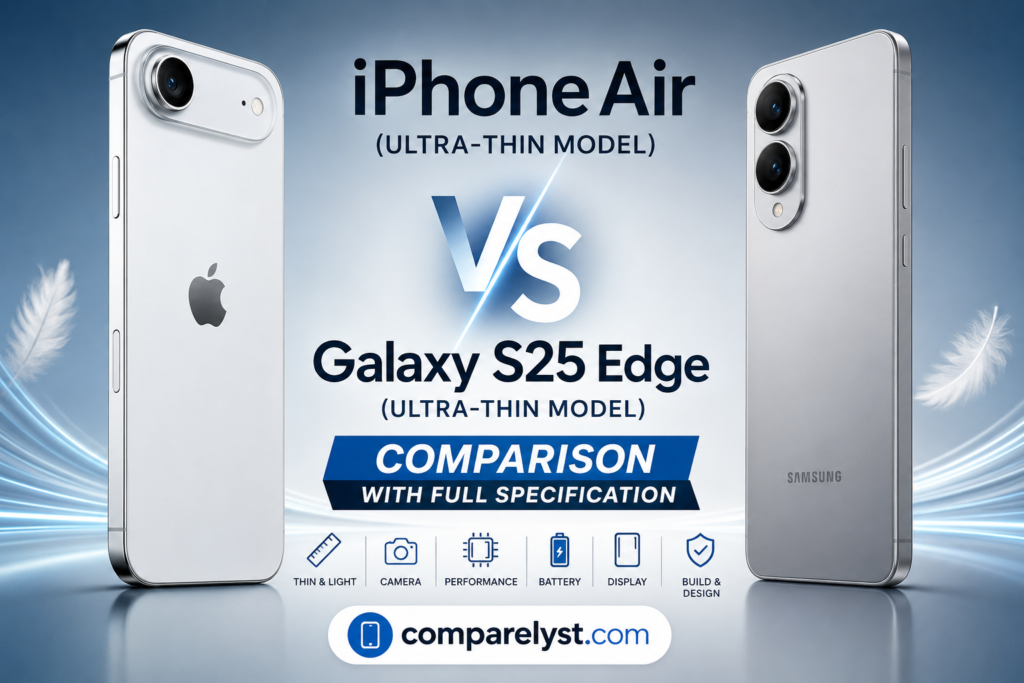
Both phones place more emphasis on slimness and portability than traditional flagship smartphone design. The iPhone Air is about 5.64 mm thick and weighs 165 grams. The Galaxy S25 Edge is 5.8 mm thick and weighs 163 grams. So on paper, both are very close.
But you can’t choose a winner based on the thickness of a smartphone alone.
Making a phone thin involves engineering challenges in many areas such as battery, camera hardware, thermal management and internal components.
So this comparison is not just a question of “which is thinner?”
Which offers a better ultra-thin smartphone experience?
That’s the main question of this article.
iPhone Air vs Galaxy S25 Edge – Design is the biggest competition
The first thing that comes to mind when looking at these two phones is not the specifications.
Design.
The main selling point of the iPhone Air is its ultra-thin body. Apple is positioning it as its thinnest iPhone. At the same time, it has tried to bring flagship-level elements like a large 6.5-inch display and A19 Pro chip into this slim body.
The Galaxy S25 Edge also adopts the same philosophy.
Samsung has made the S25 Edge one of the slimmest models in the Galaxy S series. The use of a titanium frame shows the emphasis on premium feel and durability.
Both phones are designed in a way that gives the feeling of “this is not an ordinary flagship phone” as soon as you pick it up.
The reduced thickness is a practical advantage when you put it in your pocket.
The light weight is also comfortable for users who carry the phone in their hands all day.
Here the Galaxy S25 Edge gets a slight advantage. Its weight is around 163 grams, the iPhone Air around 165 grams. But I can’t say that these two gram differences will make a huge difference in everyday usage.
So in the design category, both phones are very close.
Is Ultra-Thin Design really necessary?
This is an important question.
A phone being thin is a good thing.
But thinness alone does not improve the smartphone experience.
Just because a phone is 5.6 mm or 5.8 mm doesn’t automatically make the camera better. Battery life doesn’t automatically increase. Gaming performance doesn’t.
So the real benefit of an ultra-thin design is portability and comfort.
This design is very attractive to those who don’t want their phone to be too bulky in their pocket.
Travelers, office users, and those who hold their phone in their hands for a long time may feel the benefit of this more.
But if heavy gaming, maximum battery, or professional photography are your number one priority, you may have to accept some compromises for an ultra-thin design.
Display – iPhone Air vs Galaxy S25 Edge
The display is a very important part of both these phones.
The iPhone Air has a 6.5-inch Super Retina XDR OLED display. Apple ProMotion offers adaptive refresh rates up to 120Hz. This makes scrolling, animations and supported games very smooth.
The Galaxy S25 Edge has an even larger 6.7-inch QHD+ Dynamic AMOLED 2X display. Samsung offers adaptive refresh rates from 1Hz to 120Hz.
This gives Samsung an advantage in display size.
You watch YouTube videos.
You watch movies.
You do gaming.
You edit photos.
You browse websites.
A large screen is useful for these types of activities.
At the same time, the 6.5-inch display of the iPhone Air is also quite large.
So it is a comfortable balance for those who want a compact phone.
Samsung’s QHD+ resolution and AMOLED display quality are attractive for content consumption.
Apple’s display focuses more on color accuracy and overall visual tuning.
Both displays are premium category.
But if a large screen and high-resolution display are important, the Galaxy S25 Edge is more attractive.
Brightness and Outdoor Usage
Using the phone indoors is easy.
But when there is sunlight outside, the display quality is really tested.
Brightness is important for outdoor visibility.
The iPhone Air display has high outdoor brightness support. The Galaxy S25 Edge also uses display technologies like Samsung’s Vision Booster.
Travelers or those who work outdoors should pay attention to this aspect.
Just having a good display is not enough.
Text should be clearly visible in bright sunlight.
The screen should be readable when looking at maps.
The preview should be clear when using the camera.
Display brightness is important in these real-world situations.
Performance – Powerful despite a Thin Body?
This is where ultra-thin phone design presents an interesting challenge.
A phone needs to be thin.
At the same time, it needs flagship performance.
Balancing these two requirements is not easy.
The iPhone Air uses the Apple A19 Pro chip. It comes with a powerful CPU and GPU architecture. Apple positions this device to handle demanding tasks like graphics-intensive gaming and Apple Intelligence.
The Galaxy S25 Edge uses the Galaxy-specific Snapdragon 8 Elite processor. Samsung uses it for flagship performance and AI capabilities.
In normal daily usage, both phones are very fast.
Instagram.
YouTube.
WhatsApp.
Chrome.
Banking apps.
Photo editing.
Video calls.
The performance is enough to handle all of these comfortably.
The difference is most noticeable in heavy gaming and demanding applications.
Gaming – Which is Better in an Ultra-Thin Phone?
When it comes to gaming, ultra-thin design is a double-edged sword.
A thin phone is comfortable in the hand.
But heat management is important during long gaming sessions.
A powerful chipset generates heat when it does a lot of processing.
How a phone manages that heat can affect sustained performance.
The iPhone Air’s A19 Pro chip is designed to handle powerful gaming and graphics tasks.
The Galaxy S25 Edge also has a flagship Snapdragon processor.
Both phones are excellent for casual gaming.
But those who do heavy gaming for two or three hours continuously should pay attention to the thermal behavior due to the ultra-thin design.
So, it is not right to choose a winner in this category based on the benchmark score alone.
Camera – Samsung’s 200MP vs iPhone’s 48MP
The camera comparison is very interesting for these two phones.
The Galaxy S25 Edge has a 200MP main camera and a 12MP ultra-wide camera. The main camera has OIS support.
The iPhone Air has a 48MP Fusion camera system. Apple has designed it to provide a high-resolution main camera and an optical-quality 2x telephoto experience.
Here’s an important point.
A 200MP camera doesn’t automatically mean it’s better than a 48MP camera.
Megapixels are only one part of camera quality.
Sensor size, lens quality, image processing, stabilization, HDR processing, and software all determine the final photo quality.
Samsung is trying to provide detail and cropping flexibility through higher resolution.
Apple is focusing more on image processing and consistency.
For a normal user, “Which phone has more megapixels?” is not the most important question when taking photos.
“Which phone produces the photos I want?” is the most important question.
Portrait Photography
Portrait photography is now very popular among smartphone users.
Background separation and skin tone are very important when taking people photos, family photos and social media portraits.
Apple focuses more on skin tones and computational processing in iPhone photography.
Samsung’s processing style can sometimes give a more vibrant and detailed look.
Which style you prefer is a personal preference.
A user who likes natural-looking portraits may like one phone.
A user who likes bright and punchy photos may like another phone.
So there is no universal winner in the portrait category.
Video Recording – iPhone Air’s Strong Area
Video recording is a traditional strength of the iPhone in the smartphone camera experience.
The iPhone Air offers 4K Dolby Vision recording and stabilization-related features. It also has features like Dual Capture.
This is useful for social media creators, vloggers and short-video creators.
The Samsung Galaxy S25 Edge also has strong video capabilities.
But if you’re going to use the phone as your primary video camera, the iPhone Air’s video ecosystem may be more attractive.
Instagram Reels.
YouTube Shorts.
Travel videos.
Family events.
Consistent video output is important in these situations.
Selfie Camera – A New Approach
The iPhone Air has an 18MP Center Stage front camera.
Its main advantage is group selfies and framing flexibility.
Center Stage technology is used to smartly handle camera composition if there are multiple people in the same frame.
The Samsung Galaxy S25 Edge has a 12MP front camera.
Both phones are useful for social media and video calls.
But for those who use features like group selfies and automatic framing a lot, the iPhone Air is interesting.
Battery – Will there be a compromise due to thinness?
Battery is a very important discussion in ultra-thin smartphone design.
There may be less space for the battery inside the phone.
Therefore, manufacturers should focus on power efficiency and software optimization rather than just looking at battery size.
The Galaxy S25 Edge has a 3,900mAh battery.
Rather than comparing the battery capacity of the iPhone Air with numbers alone, we should look at Apple’s actual battery performance claims and usage optimization.
Apple positions the iPhone Air to provide all-day battery life.
The battery experience may be acceptable for normal users.
But if you are a heavy gamer or video creator, the battery drain may be faster.
Therefore, an ultra-thin phone buyer should understand one important thing.
When making thinness a priority, maximum battery capacity cannot be a priority.
Charging Experience
How long a phone battery lasts is important.
Similarly, how quickly it charges after the battery gets low is also important.
Charging speed is a practical advantage for travelers and heavy users.
Fast charging and wireless charging options have been available in the Samsung ecosystem for a long time.
The Apple ecosystem also has wired and wireless charging convenience.
But you can’t choose a charging winner based on ultra-thin design alone.
Your daily routine is what matters.
Charging speed is not a big issue if you charge your phone all night.
Charging speed is important if you need a quick top-up at the office or while traveling.
AI Features – Apple vs Galaxy AI
AI features are the biggest selling point in the 2026 smartphone market.
The iPhone Air has Apple Intelligence features. Apple integrates them in areas like communication, image creation and visual intelligence.
The Galaxy S25 Edge uses Galaxy AI features.
Samsung’s AI ecosystem is used in many areas like photo editing, search, communication and productivity.
Both companies are making AI a part of the smartphone experience.
But having more AI features doesn’t automatically make a phone better.
What matters is which feature you use on a daily basis.
If you do a lot of photo editing, AI editing is useful.
If you travel, translation is useful.
If you work, summarization and writing assistance are useful.
This category will not be of much importance to users who do not use AI features.
Software – iOS vs One UI
In this comparison, the software difference is bigger than the hardware.
The iPhone Air runs on iOS.
The Galaxy S25 Edge uses the Android platform with Samsung One UI.
iOS is simple and consistent.
Apps and hardware integration are very controlled.
The iPhone experience is very smooth if you have devices like Mac, iPad, Apple Watch and AirPods in the Apple ecosystem.
Samsung One UI places a lot of importance on customization and flexibility.
Widgets.
Multitasking.
Home screen customization.
AI tools.
Galaxy ecosystem.
More freedom for Android users.
So the software winner is not a technical specification.
It’s personal preference.
Ecosystem – What are you already using?
It’s no longer enough to make decisions with just one phone.
Do you have a laptop?
What is a smartwatch?
What are earbuds?
What is a tablet?
What is a cloud service?
The smartphone connects to all these devices.
If you are already in the Apple ecosystem, the iPhone Air is a natural upgrade.
If you are in the Samsung ecosystem, the Galaxy S25 Edge is a logical choice.
For users who use Windows PC and Google services a lot, the Android experience may be comfortable.
Durability – Is a Thin Phone Fragile?
When it comes to an ultra-thin phone, the immediate question that comes to mind is “Will this be fragile?”
That is a reasonable concern.
Manufacturers should pay more attention to materials and internal structure when achieving thinness.
The iPhone Air uses titanium design and protective materials like Ceramic Shield 2. Apple also highlights the scratch resistance and durability of the front glass.
The Galaxy S25 Edge uses titanium frame and Gorilla Glass Ceramic 2.
Just because both phones are thin doesn’t automatically mean they are weak.
But when buying an expensive slim phone, it is practical to use a good case and screen protection.
Everyday Use – Which phone is more comfortable?
How comfortable the phone is in daily usage is very important.
If you keep the phone in your pocket a lot, the thin design advantage.
If you hold the phone in your hand for a long time, the lower weight advantage.
Both phones are strong in this category.
iPhone Air is about 165g.
Galaxy S25 Edge is about 163g.
The difference is very small.
So you can’t choose a winner based on weight alone.
Screen size and hand feel are more important.
Galaxy S25 Edge has a larger display.
iPhone Air has a slightly smaller display.
iPhone Air is for those who want a compact feel.
Samsung is for those who want a large-screen experience.
Content Consumption – Which for Movies and YouTube?
Screen size is important for those who watch movies and YouTube a lot on their phone.
Galaxy S25 Edge’s 6.7-inch display is an advantage in this category.
The QHD+ resolution and AMOLED panel offer a high-quality content viewing experience.
The iPhone Air’s 6.5-inch display is also a large and high-quality OLED screen.
So both phones are excellent for content consumption.
But if you think “I want a big screen on my phone”, the Galaxy S25 Edge is slightly more attractive.
Productivity – Which for work?
If work-related usage is high, software features are important.
Samsung One UI’s multitasking flexibility is useful for productivity users.
Galaxy experience is attractive for users who use multiple applications and windows.
Apple ecosystem integration is a big advantage in the iPhone Air.
Files, photos and other ecosystem features can be seamless for MacBook users.
So the winner will be based on work setup.
Who is the iPhone Air for?
The iPhone Air is especially interesting for users who want a thin and lightweight iPhone experience.
Those who are already in the Apple ecosystem can consider it.
Those who like iOS simplicity.
Video recording is important.
Want a premium design.
Want a large display.
But don’t want a big and heavy phone like the Pro Max.
This combination suits you, but the iPhone Air is a logical choice.
Who is the Galaxy S25 Edge for?
The Galaxy S25 Edge is for those who want both Android flexibility and an ultra-thin design.
Those who like Samsung display quality.
Want a large screen.
Those who want high-resolution camera hardware like a 200MP camera.
Those who want to use Galaxy AI features.
Users who like Android customization.
This profile matches you, but the S25 Edge is more attractive.
iPhone Air vs Galaxy S25 Edge – Who is the Winner?
Both phones approach the ultra-thin smartphone concept in different ways.
Design and portability – Both phones are very close.
Display size and resolution – Galaxy S25 Edge advantage.
Performance – Both are flagship-level.
Camera resolution – Galaxy S25 Edge advantage.
Video experience – iPhone Air strong.
AI ecosystem – Both are strong, but the approach is different.
Customization – Galaxy S25 Edge advantage.
Apple ecosystem – iPhone Air advantage.
Android ecosystem – Galaxy S25 Edge advantage.
Weight – Galaxy S25 Edge has a slight advantage.
Ultra-thin experience – Both standout.
Final Verdict – iPhone Air vs Galaxy S25 Edge
The iPhone Air and Galaxy S25 Edge are not just two flagship smartphones.
These are devices that show where smartphone design can go.
A phone needs to be powerful.
It needs to be thin and light at the same time.
Achieving this balance is the biggest attraction of these two phones.
The iPhone Air’s biggest strengths are the Apple ecosystem, A19 Pro performance, iOS experience, video capabilities and ultra-thin titanium design.
The Galaxy S25 Edge’s biggest strengths are the large AMOLED display, high-resolution camera, Android flexibility, Galaxy AI and ultra-thin titanium design.
If you’re already in the iPhone ecosystem, the iPhone Air is a very natural choice.
If you’re an Android user and like the Samsung ecosystem, the Galaxy S25 Edge is very logical.
Don’t make a decision based on camera megapixels alone.
Don’t make a decision based on thickness alone.
Look at your actual daily usage first.
Do you take a lot of photos?
Do you create videos?
Do you do gaming?
Do you watch movies?
Do you work and multitask?
Do you already have Apple devices?
Do you use the Samsung ecosystem?
The answers to these questions will help you choose the right phone.
Finally, a simple conclusion:
iPhone Air – For those who want a slim iPhone experience, iOS ecosystem and a strong video experience.
Galaxy S25 Edge – Slim Android flagship, for those who want a large AMOLED display, high-resolution camera and customization.
These two phones should definitely be on the shortlist for anyone looking to buy an ultra-thin smartphone in 2026.
But rather than asking “Which is the best ultra-thin phone in the world?”
“Which ultra-thin phone is best for my usage?”
is the smart buying decision.
Comparelyst.com – Compare. Decide. Buy Smart.
Frequently Asked Questions
- iPhone Air or Galaxy S25 Edge – Which is thinner?
Both phones are very thin. The iPhone Air is about 5.64 mm thick, while the Galaxy S25 Edge is 5.8 mm thick.
2. Does the Galaxy S25 Edge have a larger display?
Yes. The Galaxy S25 Edge has a 6.7-inch Dynamic AMOLED 2X display. The iPhone Air has a 6.5-inch OLED display.
3. Which is better for camera?
The Galaxy S25 Edge has a high-resolution 200MP main camera. The iPhone Air has a 48MP Fusion camera system. But megapixels alone do not determine camera quality. Image processing, stabilization, and software are also important.
4. Which phone is better for video recording?
The iPhone Air is a very attractive option for video-focused users. It offers 4K Dolby Vision recording and advanced video features.
5. Which phone is better for gaming?
Both phones have flagship-level processors. Both are capable of casual and demanding gaming. Thermal behavior and battery drain during long gaming sessions should also be considered.
6. How much battery does the Samsung S25 Edge have?
The Galaxy S25 Edge has a typical battery capacity of 3,900mAh. Actual battery life will vary based on usage and network conditions.
7. Is the iPhone Air battery good?
Apple positions the iPhone Air as offering all-day battery life. Actual battery life will vary depending on brightness, network, apps, and usage patterns.
8. Is it worth buying an ultra-thin phone?
If lightweight design, pocket comfort, and a premium thin form factor are important to you, then it’s worth it. But if maximum battery or heavy gaming are your top priorities, it’s also a good idea to compare traditional flagship models.
9. Who is the best iPhone Air for?
The iPhone Air is a good choice for those who want the Apple ecosystem, iOS simplicity, strong performance, video recording, and a thin/light design.
10. Who is the best Galaxy S25 Edge for?
The Galaxy S25 Edge is a good choice for those who want Android customization, a large AMOLED display, a high-resolution camera, Galaxy AI, and a slim Samsung design.
11. iPhone Air vs Galaxy S25 Edge Which is slimmer?
Both phones are built with an ultra-thin design in mind. The iPhone Air is about 5.64mm thick, while the Galaxy S25 Edge is about 5.8mm thick. Thinness is an important design feature in both.
12. iPhone Air or Galaxy S25 Edge – Which is better in terms of display?
The Galaxy S25 Edge has a large 6.7-inch AMOLED display. The iPhone Air has a 6.5-inch OLED display. Those who want a large screen and high-resolution Android display can go for the Galaxy S25 Edge. Those who want the display quality and smooth experience of the iPhone, the iPhone Air is a good option.
13. Which is better for camera, the iPhone Air or Galaxy S25 Edge?
The Galaxy S25 Edge offers a higher resolution 200MP main camera. The iPhone Air uses a 48MP Fusion camera system. But megapixels alone do not determine camera quality. Image processing, stabilization, colors, and software optimization are also important.
At Comparelyst.com, you can easily find the information you need to buy your next smartphone through smartphone comparisons, camera guides, display comparisons, performance articles, and mobile technology information.